
Anolis binotatus PETERS, 1863

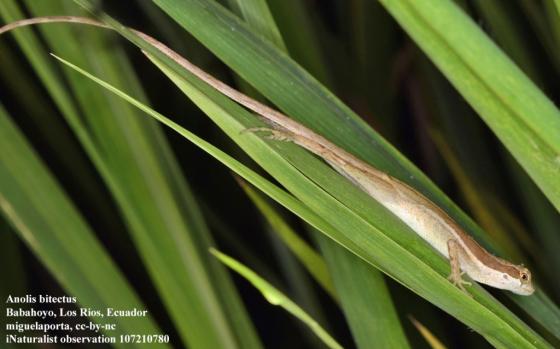
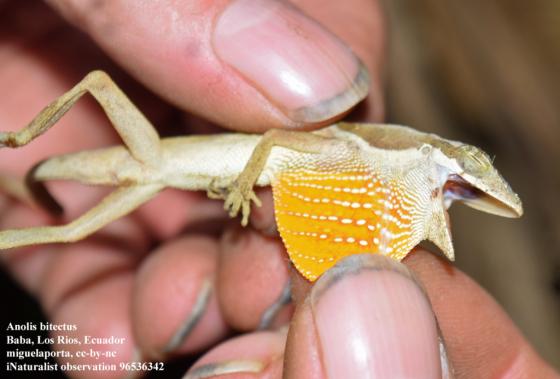


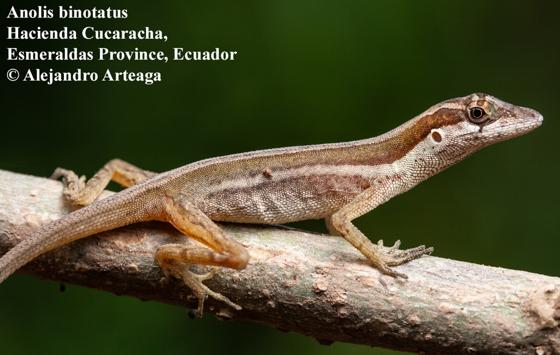

Can you confirm these amateur observations of Anolis binotatus?
Anolis binotatus
Find more photos by Google images search: 
| Higher Taxa | Anolidae, Iguania, Sauria, Squamata (lizards) |
| Subspecies | |
| Common Names | E: Two-marked Anole E: Roof Anole [bitectus] |
| Synonym | Anolis binotatus PETERS 1863: 140 Anolis bitectus COPE 1864: 171 Anolis bitectus — BOULENGER 1885: 71 Anolis binotatus — BOULENGER 1885: 80 Anolis lemniscatus BOULENGER 1898: 113 Anolis lemniscatus — PETERS & DONOSO-BARROS 1970: 57 Anolis bitectus — PETERS & DONOSO-BARROS 1970: 49 Anolis binotatus — BAUER et al. 1995: 58 Norops bitectus — NICHOLSON 2002 Norops lemniscatus — NICHOLSON 2002 Norops lemniscatus — NICHOLSON et al. 2012 Norops bitectus — NICHOLSON et al. 2012 Anolis binotatus — NICHOLSON et al. 2012 (nomen dubium) Norops binotatus — NICHOLSON et al. 2012 Norops binotatus — NICHOLSON et al. 2018 (nomen dubium) Norops bitectus — NICHOLSON et al. 2018 Norops lemniscatus — NICHOLSON et al. 2018 |
| Distribution | Ecuador, Colombia Type locality: “Guayaquil” bitectus (invalid): Ecuador; Type locality: West Ecuador lemniscatus (invalid): W Ecuador; Type locality: Chimbo, Ecuador |
| Reproduction | oviparous |
| Types | Holotype: ZMB 4685 Syntypes: BMNH 1946.8.5.83, 1946.8.20.11 (2) [bitectus] Holotype: MRSN (= MSNTO) R2650 [lemniscatus] |
| Diagnosis | Diagnosis: Anolis binotatus belongs to the Draconura, Norops, and Digilimbus clades of Poe et al., 2017 based on work presented here and the phylogenetic tree of Poe et al. (2017). Within Draconura, A. binotatus forms a clade with A. datzorum Köhler et al., 2007, A. gracilipes Boulenger, 1898, A. notopholis Boulenger, 1896 and A. salvini Boulenger, 1885. Anolis binotatus is readily distinguished from these forms by its enlarged middorsal scale rows (middorsals not distinctly enlarged in A. datzorum and A. salvini); its whitish-brown dorsum, with a straight brown stripe behind eye extending above tympanum, and by having 7−14 enlarged middorsal scale rows (greenish brown dorsum with an irregular brown stripe behind eye extending above tympanum, and 9−17 enlarged middorsal scale rows in A. gracilipes); and its lack of a black line from eye to nostril below canthus rostralis (present in A. notopholis). Anolis binotatus is a brown, small anole (maximum recorded SVL 54.1 mm in males, 55.2 mm in females). Compared to other anoles belonging to the Draconura clade from western Ecuador, it can be distinguished from A. granuliceps Boulenger, 1898 (character states in parentheses) by having a larger size, keeled ventral scales, and a large dewlap past arms well on to chest in males (maximum SVL 49 mm, smooth or very faintly keeled ventral scales, and a small dewlap to arms in males of A. granuliceps). Anolis binotatus differs from A. lynchi Miyata, 1985 in having larger head scales, 6−15 scales across the snout between the second canthals (smaller head scales, 16−29 between second canthals in A. lynchi). Anolis binotatus differs from A. lyra Poe et al., 2009 in having an orange dewlap in males and no dewlap in females (male dewlap red with dark central blotch; female dewlap present, usually blue or white with dark central blotch in A. lyra), and in possessing fewer toe lamellae, 10−15 (16−21 in A. lyra). Anolis binotatus differs from A. maculiventris Boulenger, 1898 in having keeled ventral scales (smooth in A. maculiventris), and from A. parvauritus Williams, 1966 in its brown dorsum (green in A. parvauritus). Anolis binotatus is most similar morphologically to A. gracilipes but differs from it in having 7−14 enlarged middorsal scale rows (9−17 in A. gracilipes); larger ventral scales, 3−7 in 5% SVL (5−11 in 5% SVL in A. gracilipes); a straight brown stripe behind eye extending above tympanum (irregular brown stripe behind eye extending above tympanum in A. gracilipes), a “V” shaped band on the snout, pointing backward (band absent in A. gracilipes), and dorsum of body whitish brown (greenish brown in A. gracilipes; see also genetic distances in the Phylogenetic Relationships section above). Finally, A. sagrei Duméril & Bibron, 1837 (Trachypilus clade), a species recently introduced in Ecuador (Amador et al. 2017) is similar to A. binotatus in having a brown body dorsum, and ventral scales keeled and larger than dorsals. However, A. sagrei differs from A. binotatus in lacking enlarged middorsal scale rows, having an orange, yellow, or red dewlap with a yellow border, and possessing a laterally more strongly compressed tail. (Ayala-Varela et al. 2025) Unfortunately we had to temporarily remove additional information as this was scraped by multiple AI companies who sell that data. However, these details, e.g. detailed descriptions (about about 5.33 pages) are available for collaborators and contributors. Please contact us if you need any of this material. |
| Comment | Synonymy: Ayala-Varela et al. (2025) synonymized A. bitectus and A. lemniscatus with A. binotatus. Distribution: NOT in Panama. This was an error by Barbour (1923) who misidentified A. vittigerus (according to Kohler 2008). Species group (bitectus): Norops auratus Species Group (fide Nicholson et al. 2012) NCBI taxonID: 323571 [bitectus] RDB speciesID: 10702 [bitectus] RDB speciesID: 10842 [lemniscatus] Etymology (bitectus): Named after Latin bitectus, having two covers. [“...with scales broad as long, 1 - 3 keeled, those between ridge rows much smaller, minute, yet flat, one row between the double rowed superciliaries...”]. (from Esteban Lavilla, pers. comm., May 2024) Etymology (lemniscatus): Named after Latin lemniscatus, ribboned. [“...a V-shaped band on the snout, pointing backwards ; a cross-band from eye to eye; a band behind the eye, passing above the tympanum; a series of large spots or oblique bars on the sides of the body...”]. (from Esteban Lavilla, pers. comm., May 2024) Abundance (lemniscatus): only known from its original description (Meiri et al. 2017). |
| Etymology | Named after Latin bi, two and Latin notatus, marked, signed. [“...wird hier jederseits von einem schiefen kurzen schwarzen weisseingesassten Strich begrenzt...“]. (from Esteban Lavilla, pers. comm., May 2024) |
| References |
|
| External links |
|