
Anolis polylepis PETERS, 1874
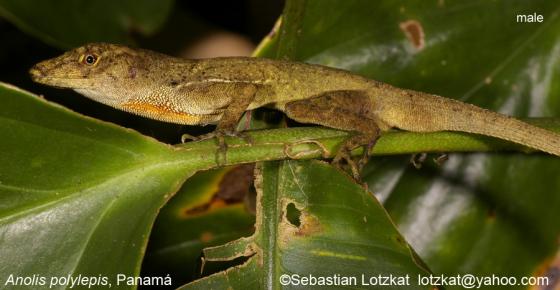
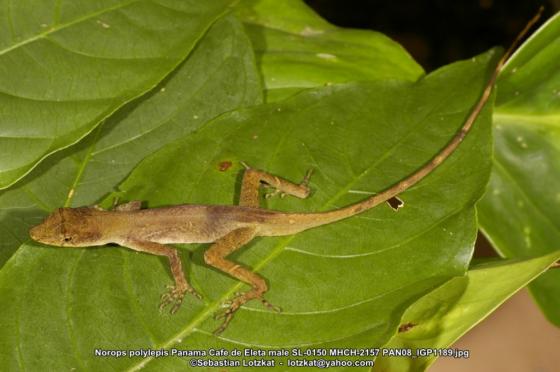
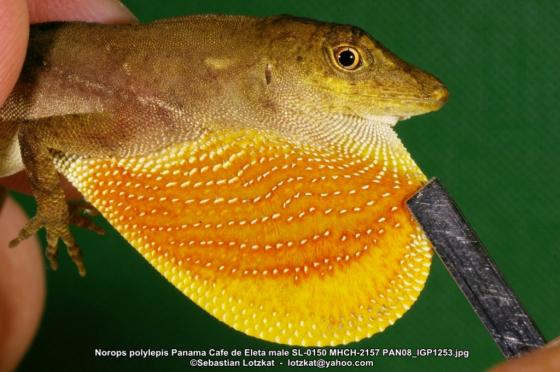
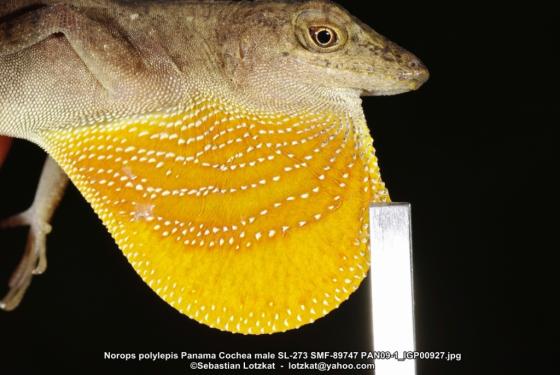
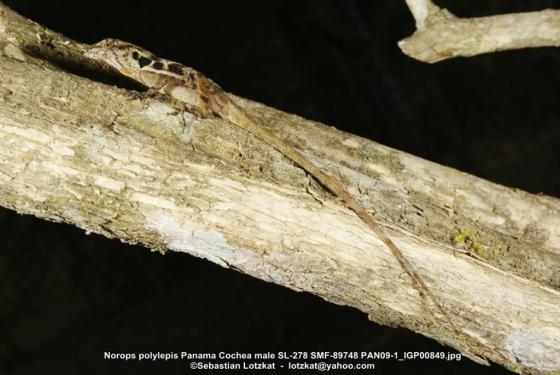
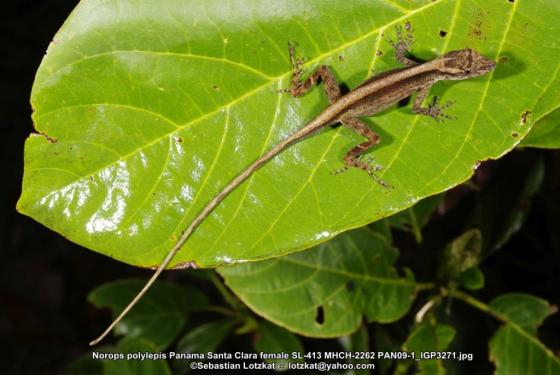
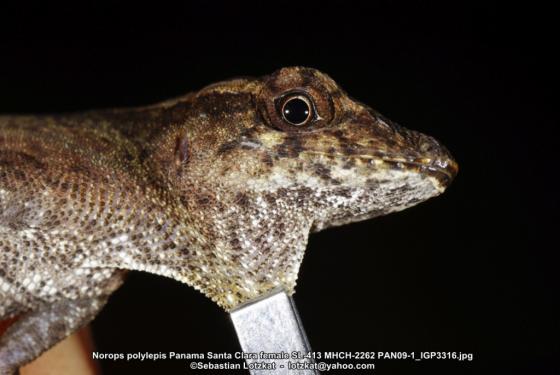
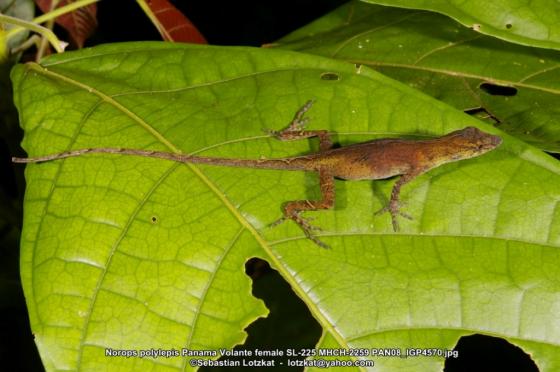
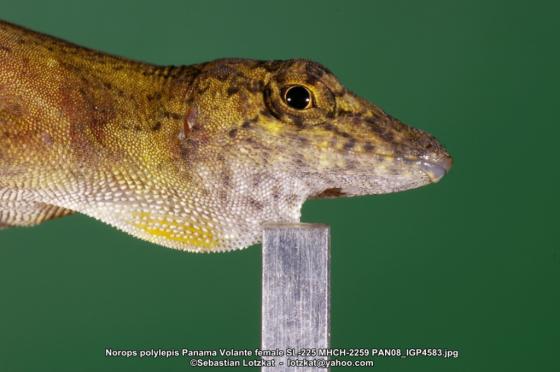
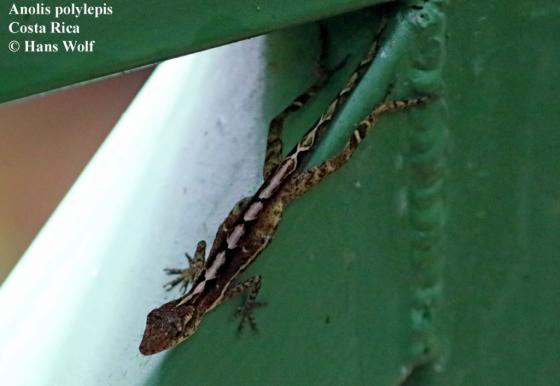



Can you confirm these amateur observations of Anolis polylepis?
Anolis polylepis
Find more photos by Google images search: 
| Higher Taxa | Anolidae, Iguania, Sauria, Squamata (lizards) |
| Subspecies | |
| Common Names | E: Many-scaled Anole |
| Synonym | Anolis polylepis PETERS 1874: 738 Anolis polylepis — BOULENGER 1885: 52 Anolis polylepis — TAYLOR 1956: 87 Anolis polylepis — PETERS & OREJAS-MIRANDA 1970 Norops polylepis — VILLA et al. 1988 Anolis polylepis — BAUER et al. 1995: 59 Norops polylepis — KÖHLER 2000: 63 Norops polylepis — NICHOLSON 2002 Anolis polylepis — COOPER 2005 Anolis osa KÖHLER, DEHLING & KÖHLER 2010 Norops osa — NICHOLSON et al. 2012 Norops polylepis — NICHOLSON et al. 2012 Norops polylepis — NICHOLSON et al. 2018 Norops osa — NICHOLSON et al. 2018 Anolis polylepis — POE 2025 |
| Distribution | W Panama, SW Costa Rica (exclusive of the Penisula de Osa), 0-1615 m elevation Type locality: “Chiriqui” [Panama] osa (invalid): Costa Rica (Osa Peninsula); Type locality: about 6.3 km WSW Rincón de Osa, 8°40’36.7’’N, 83°32’7.9’’W, about 150 m elevation, Puntarenas Province, Costa Rica. |
| Reproduction | oviparous |
| Types | Syntypes: ZMB, MCZ 21962-63 (fide CRUMLY 1986) Holotype: SMF 80645, an adult male, collected 22 February 2008 by Gunther Köhler and Johannes Köhler. Field tag number GK 2092. [osa] |
| Diagnosis | Diagnosis: A medium-sized species (SVL in largest specimen 59.4 mm) of the genus Anolis (sensu Poe 2004) that differs from all other Lower Central American beta anoles (sensu Etheridge 1967) except Anolis apletophallus, A. cryptolimifrons, and A. limifrons in that it is long-legged (longest toe of adpressed hind leg reaches to at least center of eye), has smooth ventral scales, and a slender habitus, often delicate. Anolis polylepis differs from the species in the cluster listed above by having two elongate, overlapping superciliaries (one such scale in A. apletophallus, A. cryptolimifrons, and A. limifrons), usually two anterior prenasal scales (versus one elongate prenasal scale) and dewlap coloration (usually orange with a darker orange basal portion in A. polylepis versus dirty white with a basal orange-yellow blotch in A. cryptolimifrons and A. limifrons, almost uniformly orange-yellow in A. apletophallus). Additionally, A. polylepis differs from A. limifrons, the only species of this cluster with which it occurs sympatrically, by having a bilobed hemipenis (unilobed in A. limifrons) [from KÖHLER et al. 2010]. Unfortunately we had to temporarily remove additional information as this was scraped by multiple AI companies who sell that data. However, these details, e.g. detailed descriptions (about less than half a page) are available for collaborators and contributors. Please contact us if you need any of this material. |
| Comment | Hybridization: A. osa and A. polylepis form a hybrid zone, i.e. they may hybridize desprite their different hemipenes (Köhler et al. 2012, Salamandra). Species group: Norops auratus Species Group (fide Nicholson et al. 2012) Synonymy: GenBank had KP100436 (POE 2276) as A. zeus but is treated as A. polylepis in Köhler 2015. Anolis osa is a cryptic species related to A. polylepis (Pacific versant of central and southern Costa Rica and western Panama, excluding the Osa Peninsula). A. osa is restricted to the Osa Peninsula. The two species differ in hemipenial morphology (hemipenis bilobed in A. polylepis versus unilobed in the species from the Osa Peninsula) but show no discernable differences in external morphology (i.e., morphometrics, scalation, coloration, male dewlap). Hybridization: A. osa and A. polylepis form a hybrid zone, i.e. they may hybridize despite their different hemipenes (Köhler et al. 2012, Salamandra). NCBI taxonID: 980506 [osa] RDB speciesID: 10916 [osa] Etymology (osa): The name osa is used as a noun in apposition and in reference to the Peninsula de Osa where the type series of the species was collected and where it is probably restricted. |
| Etymology | Named after Greek polys (πολύς), several + Greek lepis (λεπίς), scale. [“...Mittlere Rückenschuppen gekielt, kleiner als die Bauchschuppen und etwas grösser als die granulirten Seitenschuppen...”]. |
| References |
|
| External links |