You are here » home search results Anolis tropidolepis

Anolis tropidolepis BOULENGER, 1885

Can you confirm these amateur observations of Anolis tropidolepis?

Add your own observation of
Anolis tropidolepis »

Find more photos by Google images search: Google images

Higher TaxaAnolidae, Iguania, Sauria, Squamata (lizards)
Subspecies 
Common NamesE: Swift Anole 
SynonymAnolis tropidolepis BOULENGER 1885: 53
Anolis tropidolepis — GÜNTHER 1885: 46
Anolis curtus BOULENGER 1898: 919
Anolis tropidolepis — TAYLOR 1956: 146
Anolis curtus — TAYLOR 1956: 151
Anolis tropidolepis — PETERS & OREJAS-MIRANDA 1970: 68
Norops tropidolepis — GUYER & SAVAGE 1986
Norops curtus — GUYER & SAVAGE 1986
Norops tropidolepis — KÖHLER 2000: 63
Norops tropidolepis — NICHOLSON 2002
Norops tropidolepis — NICHOLSON et al. 2012
Norops alocomyos KÖHLER, VARGAS & LOTZKAT 2014
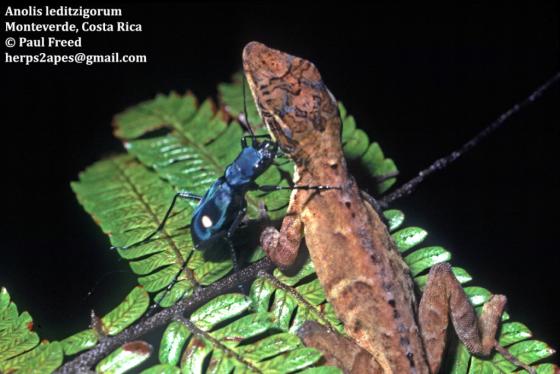
Norops leditzigorum KÖHLER, VARGAS & LOTZKAT 2014
Anolis leditzigorum — TARR et al. 2018
Anolis alocomyos — TARR et al. 2018
Norops tropidolepis — NICHOLSON et al. 2018
Norops alocomyos — NICHOLSON et al. 2018
Norops leditzigorum — NICHOLSON et al. 2018
Anolis tropidolepis — POE 2025 
DistributionCosta Rica (Volcán Irazu, Monteverde), 1600-2600 m elevation.

Type locality: Irazu, Costa Rica.

alocomyos (invalid): Costa Rica (San José); Type locality: road between Santa María de Dota and Copey, 9.65696°N, 83.94831°W, elev. 1,720 m asl, Provincia de San José, Costa Rica

leditzigorum (invalid): Costa Rica (Puntarenas); Type locality: 4 km (on road) N Santa Elena, 10.34156°N, 84.80506°W, elev. 1,560 m asl, Provincia de Puntarenas, Costa Rica  
Reproductionoviparous 
TypesHolotype: BMNH
Holotype: BMNH [curtus]
Holotype: SMF 93635 (KP209362), adult male; collected by Gunther Köhler on 21 February 2010; original field number GK-2405. Paratypes: Collected by Gunther Köhler on 21 February 2010. All from Provincia de San José, Costa Rica: SMF 93636 (KP209363), along the road between Santa María de Dota and Copey, 9.64955°N, 83.93845°W, elev. 1,850 m; SMF 93637 (KP209364), 93638–41, along the road between Copey and Providencia, 9.61539°N, 83.90802°W, elev. 2,370 m; SMF 93642, along the road between Copey and Providencia, 9.61008°N, 83.90865°W, elev. 2,540 m. SMF 93636–37, 93642 are adult males, the remaining paratypes are adult females. [alocomyos]
Holotype: SMF 85538, adult male; collected by Gunther Köhler on 5 April 2006; original field number GK-1752. Paratypes: All collected by Gunther Köhler in Provincia de Puntarenas, Costa Rica: SMF 85539, same collecting data as holotype; SMF 89319–20, UCR 20140–43, 2 km N Santa Elena, 10.34181°N, 84.80444°W, elev. 1,550 m, collected on 17 February 2007; SMF 85532, 85533 (KP209352), 85534–37, 2.3 km N Santa Elena, 10.33189°N, 84.81289°W, elev. 1,575 m, collected on 5 April 2006; SMF 99283, near entrance to Reserva Santa Elena, 10.34308°N, 84.79720°W, elev. 1,640 m, collected on 28 October 2011; SMF 99280–81 (KP209370–71), 99282, Santa Elena, Sunset Hotel, 10.34384°N, 84.80268°W, elev. 1,580 m, collected on 28 October 2011. UCR 20142, SMF 85532–33, 85539, 89319–20, 99280, and 99283 are adult males, the remaining paratypes are adult females. [leditzigorum] 
DiagnosisUnfortunately we had to temporarily remove additional information as this was scraped by multiple AI companies who sell that data. These details, e.g. detailed descriptions are available for collaborators and contributors. Please contact us if you need any of this material. 
CommentSynonymy: we follow Poe 2025 who suggested to synonymize alocomyos and leditzigorum with Anolis tropidolepis “because there are no known diagnostic morphological or molecular traits with which workers in the field could distinguish these putative species” and because of their shallow mitochondrial differentiation.

Closest relative of A. magnacephallus.

Species group: Norops auratus Species Group (fide Nicholson et al. 2012)

NCBI taxonID: 1638968 [alocomyos]
RDB speciesID: 20145 [alocomyos]
NCBI taxonID: 1638967 [leditzigorum]
RDB speciesID: 20146 [leditzigorum]

Etymology (alocomyos): The specific name alocomyos is a compound noun formed from the Greek words alox (furrow) and myo (close), referring to the closed sulcus spermaticus in this species, which is unique among the known species in the Norops pachypus complex.

Etymology (leditzigorum): The specific name is a patronym for the Leditzig family, Denmark, in recognition of the financial support of taxonomic research provided by Jørgen Leditzig through the BIOPAT initiative. 
EtymologyNamed after Greek tropideion (τροπιδεῖον), the keel + Greek lepis (λεπίς), scale. [“...Dorsal scales very small, rhomboidal, keeled...”]. 
References
  • Acosta-Chaves, Víctor J.; Gerardo Chaves, Juan G. Abarca, Adrián García-Rodríguez, Federico Bolaños 2015. A checklist of the amphibians and reptiles of Río Macho Biological Station, Provincia de Cartago, Costa Rica. Check List 11 (6): 1784 - get paper here
  • Boulenger, G.A. 1885. Catalogue of the lizards in the British Museum (Natural History). Vol. 2, Second edition. London, xiii+497 pp. - get paper here
  • Boulenger, G.A. 1898. Third report on additions to the lizard collection in the Natural History Museum. Proc. Zool. Soc. London 1898: 912-923. - get paper here
  • Fitch, H.S. 1972. Ecology of Anolis tropidolepis in Costa Rican Cloud Forest Herpetologica 28 (1): 10-21. - get paper here
  • Fitch, Henry S. 1973. Population structure and survivorship in some Costa Rican lizards. Occ. Pap. Mus. Nat. Hist. Univ. Kansas 18: 1-41 - get paper here
  • Günther, A. C. L. G. 1885. Reptilia and Batrachia. Biologia Centrali-Américana. Taylor, & Francis, London, 326 pp. [published in parts from 1885-1902; reprint by the SSAR 1987] - get paper here
  • Kaiser, Christine; Hinrich Kaiser 2021. Coming home to roost: comments on individual sleep-site fidelity, sleep-site choice, and sleeping positions in Anolis (Norops) leditzigorum Köhler et al., 2014 in Costa Rica (Squamata: Dactyloidae). Herpetology Notes 14: 375-378 - get paper here
  • Köhler, G. 2000. Reptilien und Amphibien Mittelamerikas, Bd 1: Krokodile, Schildkröten, Echsen. Herpeton Verlag, Offenbach, 158 pp.
  • Köhler, G. 2008. Reptiles of Central America. 2nd Ed. Herpeton-Verlag, 400 pp.
  • KÖHLER, GUNTHER 2014. Characters of external morphology used in Anolis taxonomy—Definition of terms, advice on usage, and illustrated examples. Zootaxa 3774 (2): 201–257 - get paper here
  • Köhler, Gunther, Joseph Vargas, Johannes J. Köhler and Milan Vesel´y. 2013. Noteworthy distributional records of amphibians and reptiles from Costa Rica. Herpetological Review 44 (2): 280-283 - get paper here
  • Köhler, Gunther; Joseph Vargas, and Sebastian Lotzkat 2014. Two new species of the Norops pachypus complex (Squamata, Dactyloidae) from Costa Rica. Mesoamerican Herpetology 1 (2): 254–280. - get paper here
  • LOTZKAT, SEBASTIAN; JOE-FELIX BIENENTREU,, ANDREAS HERTZ, & GUNTHER KÖHLER 2011. A new species of Anolis (Squamata: Iguania: Dactyloidae) formerly referred to as A. pachypus from the Cordillera de Talamanca of western Panama and adjacent Costa Rica. Zootaxa 3125: 1–21 - get paper here
  • Nicholson, K.E. 2002. Phylogenetic analysis and a test of the current infrageneric classification of Norops (beta Anolis). Herpetological Monographs 16: 93-120 - get paper here
  • NICHOLSON, KIRSTEN E.; BRIAN I. CROTHER, CRAIG GUYER & JAY M. SAVAGE 2012. It is time for a new classification of anoles (Squamata: Dactyloidae). Zootaxa 3477: 1–108 - get paper here
  • NICHOLSON, KIRSTEN E.; BRIAN I. CROTHER, CRAIG GUYER & JAY M. SAVAGE 2018. Translating a clade based classification into one that is valid under the international code of zoological nomenclature: the case of the lizards of the family Dactyloidae (Order Squamata). Zootaxa 4461 (4): 573–586 - get paper here
  • Peters, James A. & Donoso-Barros, Roberto 1970. Catalogue of the Neotropical Squamata: Part II. Lizards and Amphisbaenians. Bull. US Natl. Mus. 297: 293 pp. - get paper here
  • Poe, S. 2004. Phylogeny of anoles. Herpetological Monographs 18: 37-89 - get paper here
  • Poe, S. 2013. 1986 Redux: New genera of anoles (Squamata: Dactyloidae) are unwarranted. Zootaxa 3626 (2): 295–299 - get paper here
  • Poe, S. & Ibáñez, R. 2007. A New Species of Anolis Lizard from the Cordillera De Talamanca of Western Panama. Journal of Herpetology 41 (2): 263–270 - get paper here
  • Poe, Steven 2025. A Guide to the Anolis Lizards (Anoles) of Mainland Central and South America. Princeton University Press, 432 pp. - get paper here
  • Sasa, M., Arias, E., & Chaves, G. 2025. Annotated list of amphibians and reptiles of Costa Rica: The role of the Museum of Zoology in cataloging the country’s herpetological diversity. Revista de Biología Tropical, 73(S2): e64536-e64536 - get paper here
  • Savage, J.M. 2002. The Amphibians and Reptiles of Costa Rica: A Herpetofauna Between Two Continents, Between Two Seas. University of Chicago Press, 934 pp. [review in Copeia 2003 (1): 205]
  • Tarr, S. , Meiri, S., Hicks, J. J. and Algar, A. C. 2018. A biogeographic reversal in sexual size dimorphism along a continental temperature gradient. Ecography, doi:10.1111/ecog.03593 - get paper here
  • Taylor, E. H. 1956. A review of the lizards of Costa Rica. Univ. Kansas Sci. Bull. 38 (part 1): 3-322 - get paper here
 
External links  
Is it interesting? Share with others:


Please submit feedback about this entry to the curator