
Concinnia ampla (COVACEVICH & MCDONALD, 1980)
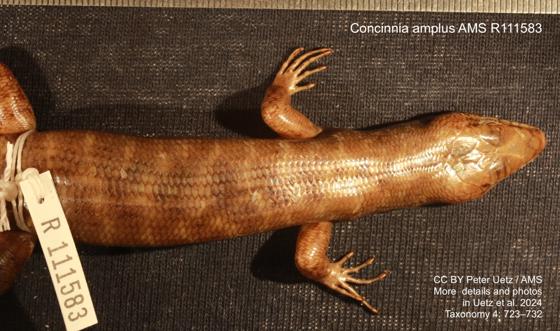

Can you confirm these amateur observations of Concinnia ampla?
Concinnia ampla
Find more photos by Google images search: 
| Higher Taxa | Scincidae, Sphenomorphinae (Sphenomorphini), Scincoidea, Sauria, Squamata (lizards) |
| Subspecies | |
| Common Names | E: Lemon-barred Forest-skink |
| Synonym | Sphenomorphus amplus COVACEVICH & MCDONALD 1980 Sphenomorphus amplus — COGGER 1983 Concinnia amplus — WELLS & WELLINGTON 1983 Eulamprus amplus — FRANK & RAMUS 1995 Eulamprus amplus — COGGER 2000: 482 Eulamprus amplus — WILSON & SWAN 2010 Concinnia amplus — SKINNER et al. 2013 Concinnia ampla — CHAPPLE et al. 2021 |
| Distribution | Australia (CE Queensland) Type locality: Finch Hatton Creek, Eungella National Park, mid-E Qld. |
| Reproduction | ovoviviparous |
| Types | Holotype: QM J26054; paratypes: QM |
| Diagnosis | DIAGNOSIS: S. amplus most closely resembles the Irian Jaya (Western New Guinea) species Otosaurus mimikanus (Boulenger 1914). It may be distinguished from O. mimikanus as follows: supranasal scales (usually 2 pairs* vs one pair); mid-body scale count (41-52 vs 40); lamellae under fourth toe (22-26 vs 15); colour and pattern (see type description Boulenger, 1914). These features also readily distinguish S. amplus from all Australian species of Sphenomorphus. No other Australian Sphenomorphus species have supranasals and only one species group has more than 40 mid-body scales. Species of the S. quoyi group have 24-44 mid-body scales (Cogger, 1975) but in addition to lacking supranasals, these species are strikingly coloured olive-brown dorsally with prominent yellow-cream dorsolateral longitudinal stripes, a pattern which is never present in S. amplus. (Covacevich & McDonald 1980) Unfortunately we had to temporarily remove additional information as this was scraped by multiple AI companies who sell that data. However, these details, e.g. detailed descriptions (about about 1.48 pages) are available for collaborators and contributors. Please contact us if you need any of this material. |
| Comment | Vocalization: this species is one of the few skinks which produce sounds when captured (O’Connor 2003). Limb morphology: 5 digits, 5 toes (Singhal et al. 2018, Brandley et al 2008) Reference images: see Uetz et al. 2024 for high-resolution reference images for this species. |
| Etymology | Presumably named after the Latin amplus (large) in reference to the body size. (G. Shea, pers. comm., 9 Feb 2024) |
| References |
|
| External links |