
Ctenosaura oaxacana KÖHLER & HASBUN, 2001

Can you confirm these amateur observations of Ctenosaura oaxacana?
Ctenosaura oaxacana
Find more photos by Google images search: 
| Higher Taxa | Iguanidae, Iguania, Sauria, Squamata (lizards) |
| Subspecies | |
| Common Names | E: Oaxaca Spiny-tailed Iguana S: Garrobo de Oxaxca |
| Synonym | Ctenosaura oaxacana KÖHLER & HASBUN 2001: 260 Ctenosaura oaxacana — MATA-SILVA et al. 2015 Ctenosaura oaxacana — HEIMES 2022 |
| Distribution | Mexico (Oaxaca) Type locality: Pacific versant of the Isthmus of Tehuantepec (Oaxaca, Mexico) |
| Reproduction | oviparous |
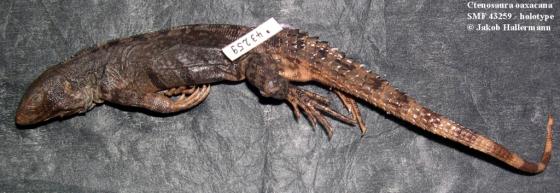
| Types | Holotype: SMF 43259, adult male Paratypes: AMNH, MZFC, SMF |
| Diagnosis | Diagnosis: Ctenosaura oaxacana n. sp. differs from C. quinque-carinata, one of its closest relatives, by its smaller size (maximum SVL 170 mm in male C. oaxacana versus 195 mm in male C. quinquecarinata; 124 mm in female C. oaxacana versus 145 mm in female C. quinquecarinata); a shorter tail (ratio tail length/SVL 1.27-1.45 in C. oaxacana versus 1.55-1.64 in C. quinquecarinata); its less spinous tail (paramedian caudal scales spinous on proximal 3-7 [mean value 4.5] of the caudal whorls in C. oaxacana versus 4-13 [mean value 6.4] of the caudal whorls in C. quinquecarinata); the condition of scales on dorsal surface of thigh (no patch of enlarged keeled scales present in C. oaxacana versus a patch that is usually present in C. quinquecarinata); a body pattern of a broad pale middorsal band which may be fragmented into large blotches (usually present in C. oaxacana versus absent in C. quinquecarinata); the smaller relative length of the anterior lateral processes of the frontal bone (lateral processes subequal or medial process projecting beyond lateral processes in C. oaxacana versus lateral processes usually projecting beyond medial process in C. quinquecarinata; Fig. 3); and a broader posterior angle of the parietal bone (ratio of width of posterior angle of parietal bone/SVL >0.09 in C. oaxacana versus <0.1 in C. quinquecarinata; Table 1). Ctenosaura oaxacana differs from C. flavidorsalis, another close relative, by having a well developed thoracic crest in adult males (middorsal crest spines usually >2 mm in C. oaxacana versus <2 mm in C. flavidorsalis); a less spinous tail (paramedian caudal scales spinous on proximal 3-7 [mean value 4.5] of the caudal whorls in C. oaxacana versus 8-13 [mean value 10.8] of the caudal whorls in C. flavidorsalis); the continuity of the dorsal crest row (nuchal and thoracic crests continuous in C. oaxacana versus gaps usually present along the crest row in C. flavidorsalis); its dorsal coloration (absence of yellow elements in C. oaxacana versus yellow elements usually present in C. flavidorsalis); its usually bifurcated jugal/lacrimal suture (versus straight in C. flavidorsalis; Fig. 4); the position of the anterior inferior alveolar foramen (associated with the splenial bone in C. oaxacana versus not in contact with the splenial bone in C. flavidorsalis; Fig. 5). Ctenosaura oaxacana can be distinguished from all remaining species of the genus except C. quinquecarinata and C. flavidorsalis by the following combination of characters: tail with whorls of enlarged spinous scales that are separated by one row of smaller intercalary scales; the median and two lateral series of each caudal whorl very large; proximal antero-dorsal surface of shank with a patch of enlarged strongly keeled scales; no dewlap; a distinct thoracic crest usually present in adult males; maximum SVL < 200 mm. (Köhler & Hasbun 2001) Unfortunately we had to temporarily remove additional information as this was scraped by multiple AI companies who sell that data. However, these details, e.g. detailed descriptions (about between half a page and a page) are available for collaborators and contributors. Please contact us if you need any of this material. |
| Comment | BURRÉ (2004) described hybridization between Ctenosaura oaxacana and Ctenosaura quinquecarinata. |
| Etymology | Named after the Mexican state of Oaxaca where the known distribution of the species is located. |
| References |
|
| External links |