
Ctenotus orientalis STORR, 1971
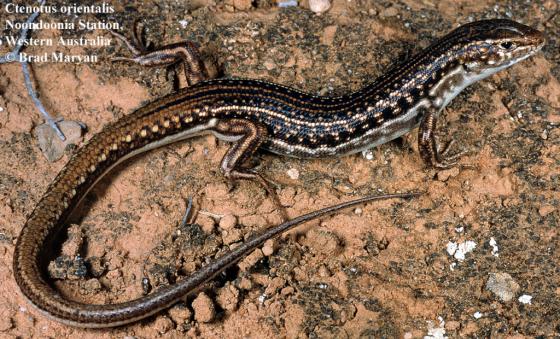

Can you confirm these amateur observations of Ctenotus orientalis?
Ctenotus orientalis
Find more photos by Google images search: 
| Higher Taxa | Scincidae, Sphenomorphinae (Sphenomorphini), Scincoidea, Sauria, Squamata (lizards) |
| Subspecies | |
| Common Names | E: Oriental Ctenotus |
| Synonym | Ctenotus uber orientalis STORR 1971 Minervascincus monaro WELLS & WELLINGTON 1985 (nom. nudum) Ctenotus orientalis — HUTCHINSON & DONELLAN 1999: 181 Ctenotus orientalis — STORR 1999 Ctenotus uber orientalis — COGGER 2000: 449 Ctenotus orientalis — GREER 2005 (online) Ctenotus orientalis — MICHAEL et al. 2011 |
| Distribution | Western Australia, Northern Territory, Queensland, New South Wales, Victoria. Type locality: Ouyen, Victoria [35°o4’S, 142°19’E] |
| Reproduction | oviparous (not imputed, fide Zimin et al. 2022) |
| Types | Holotype: NMV D825. Holotype: AMS R92239 [monaro] |
| Diagnosis | Diagnosis: Ground colour of hody beige to medium brown, without reddich tinge. Black to dark chocolate or dark reddish brown laterodorsal zone generally reduces exposure of the ground colour to a pair of paravertebral lines and a series of pale dots or dashes within each laterodorsal dark zone. Black to dark brown vortehral stripe always present and usually occupying about one third of each vertebral scale row. A pale brown to white dorsolateral stripe always present aud straigh edged. (Hutchinson & Donellan 1999) Unfortunately we had to temporarily remove additional information as this was scraped by multiple AI companies who sell that data. However, these details, e.g. detailed descriptions (about about .92 pages) are available for collaborators and contributors. Please contact us if you need any of this material. |
| Comment | See also Ctenotus schomburgkii. HUTCHINSON & DONELLAN (1999) elevated Ctenotus uber orientalis to full species status. According to these authors, STORR’s type series of uber orientalis is composite, containing orientalis, olympicus, and septenarius. Limb morphology: 5 digits, 5 toes (Singhal et al. 2018, Cogger 2014) Reference images: see Uetz et al. 2024 for high-resolution reference images for this species. |
| Etymology | From the Latin orientalis (eastern), in reference to the distribution. This species was originally described as an eastern subspecies of C. uber. (G. Shea, pers. comm., 9 Feb 2024) |
| References |
|
| External links |