
Cylindrophis jodiae AMARASINGHE, INEICH, CAMPBELL & HALLERMANN, 2015
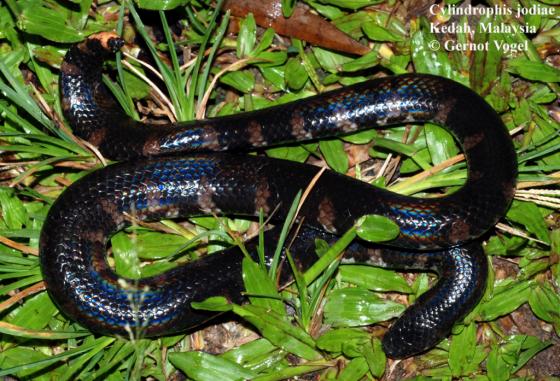
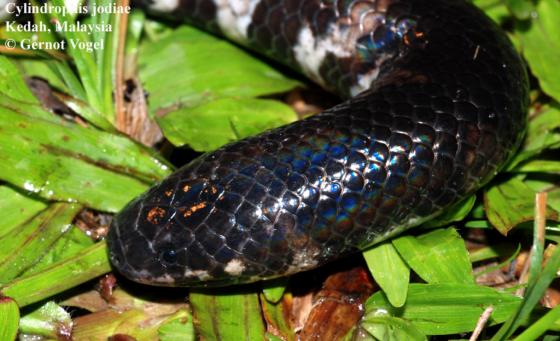
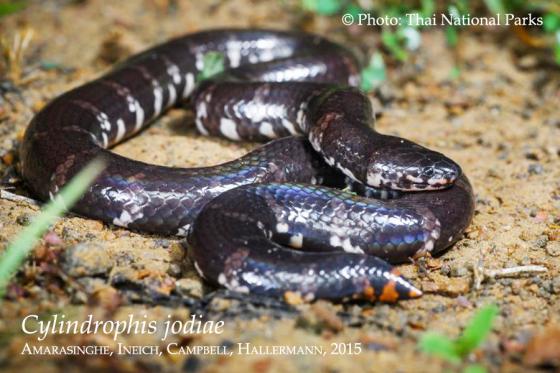

Can you confirm these amateur observations of Cylindrophis jodiae?
Cylindrophis jodiae
Find more photos by Google images search: 
| Higher Taxa | Cylindrophiidae, Henophidia, Alethinophidia, Serpentes, Squamata (snakes) |
| Subspecies | |
| Common Names | E: Jodi’s Pipe-Snake |
| Synonym | Cylindrophis jodiae AMARASINGHE, INEICH, CAMPBELL & HALLERMANN in AMARASINGHE et al. 2015 Cylindrophis jodii AMARASINGHE et al. 2015 (see comment) Cylindrophis jodiae — WANG et al. 2022 |
| Distribution | C Vietnam, China (Fujian) Type locality: Annam, Central Vietnam |
| Reproduction | viviparous (manual imputation, fide Zimin et al. 2022) |
| Types | Holotype: MNHN-RA 1911.0196, SVL 415 mm, collected by the French botanist Philippe Eberhardt, without precise date, but before 1911. Paratypes (10): MNHN-RA 1974.1251, (SVL 391 mm), collected in the area of Saigon, southern Vietnam, by Ser- gent Poilane before 1974; MNHN-RA 1885.0100–103, (SVL 265, 264, 146, 177 mm), collected in Cochinchina, southern Vietnam, by Girard before 1885; MNHN-RA 1885.0098–99, (SVL 375, 656 mm), collected in Cochinchina, southern Vietnam, by Girard before 1885; MNHN-RA 1935.0001, (SVL 271 mm), collected in Cochinchina, southern Vietnam, by René Bourret before 1935; MNHN-RA 1974.1253, (SVL 192 mm), collected in the area of Saigon, southern Vietnam, by Sergent Poilane before 1974; BMNH 1920.1.20.2649, (SVL 345 mm), collected from Long-Xuyen, Vietnam by F. Lataste, collection date unknown. |
| Diagnosis | Diagnosis: Cylindrophis jodiae sp. nov. is distinguished from all congeners by having the following characters: 21 midbody scale rows (vs. 17 in C. engkariensis; 19 in C. boulengeri, C. burmanus, C. melanotus, C. ruffus; 23 in C. aruensis, C. opisthorhodus), 182–196 ventrals (vs. 217–225 in C. isolepis), wide and interrupted bands on the back (vs. lateral and middorsal stripes along the body in C. lineatus; two series of large reddish-brown spots along the back, which are enclosed by a black network in C. maculatus; no bands and paler back in C. yamdena). |
| Comment | Nomenclature: The paper by Amarasinghe et al. (2015) exists in two versions, an earlier one, in which Fig. 8 lists the names of the new species as C. jodii and C. mirzai, and a revised version in which these errors have been corrected (Kieckbusch et al. 2016). |
| Etymology | The species epithet is an eponym latinized as a noun in the genitive singular, honoring Dr. Jodi Rowley for her generous friendship, and remarkable contributions and expeditions assessing amphibian decline due to various diseases, conservation status, and in documenting amphibian biodiversity. Jodi Rowley is an Australian herpetologist. She has conducted amphibian research in Southeast Asia, mainly in Vietnam. Currently she is a co-ordinator of Australian Museum Research Institute, a member of the IUCN Amphibian Red List Authority and the co-chair for Mainland Southeast Asia of the IUCN Species Survival Commission Amphibian Specialist Group. |
| References |
|
| External links |