
Dipsas temporalis (WERNER, 1909)


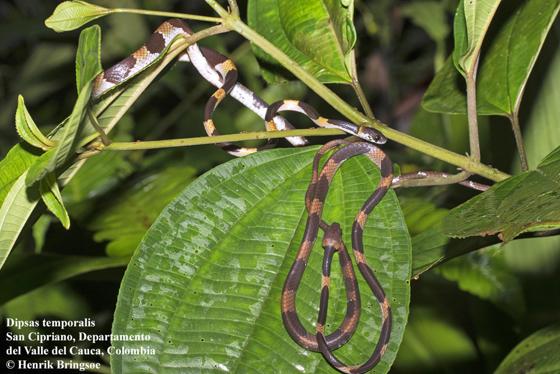
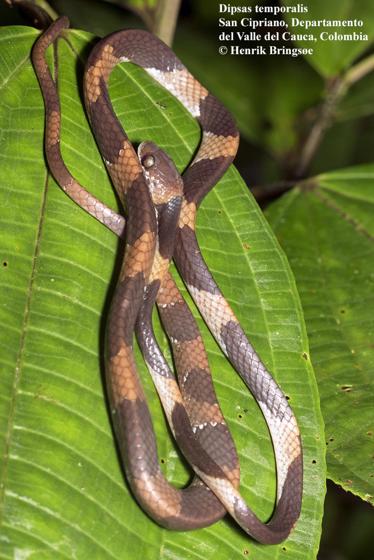



Can you confirm these amateur observations of Dipsas temporalis?
Dipsas temporalis
Find more photos by Google images search: 
| Higher Taxa | Colubridae (Dipsadinae), Colubroidea, Caenophidia, Alethinophidia, Serpentes, Squamata (snakes) |
| Subspecies | |
| Common Names | E: Temporal Snail-eater S: Caracolera Tropical de bandas rojizas |
| Synonym | Leptognathus temporalis WERNER 1909: 241 Leptognathus spurrelli BOULENGER 1913: 1036 Sibynomorphus spurellii (BOULENGER) — AMARAL 1930b:199 Sibynomorphus spurellii (BOULENGER) — AMARAL 1931:92 Sibynomorphus spurellii (BOULENGER) — RENDAHL & VESTERGREN 1940:11 Sibynon nebulatus — AMARAL 1930a:32 (not of LINNAEUS) Sibon sibon — AMARAL 1930b:68 (not of LINNAEUS) Sibon temporalis (WERNER) — DUNN and BAILEY 1939:9 Dipsas temporalis — PETERS 1960: 50 Dipsas temporalis — PETERS & OREJAS-MIRANDA 1970: 90 Dipsas temporalis — MIYATA 1982:16 Dipsas temporalis — VILLA et al. 1988 Dipsas temporalis — CADLE & MYERS 2003: 35 Dipsas temporalis — WALLACH et al. 2014: 235 Dipsas temporalis — GARCIA-COBOS et al. 2026: 738 |
| Distribution | Panama, Ecuador, Colombia (incl. Valle del Cauca, Chocó) Type locality: Esmeraldes, Ecuador, leg. Kapt. E. KRAUSE, on the ship “Nako- Kosmos-Linie”. |
| Reproduction | oviparous |
| Types | Holotype: lost, was ZMH |
| Diagnosis | Diagnosis: Dipsas temporalis differs from all congeners by the following combination of characters: (1) dorsals 15 without reduction; (2) temporals usually entering orbit on one or both sides; (3) anterior infralabials separated by pair (rarely fused) of small postmentals; (4) infralabials broadly contacting second pair of chinshields; sublabials separating infralabials from third pair of chinshields, preventrals, and ventrals; (5) loreal long, entering orbit; (6) preocular above loreal present or absent; (7) dorsal surfaces of head mostly immaculate reddish brown; (8) supralabials and sides of head black and white (not barred), with black subocular band extending onto ventral surface of head; (9) nuchal collar straw-colored; first band, incomplete ventrally, not reaching rictus and separated from parietals by 1–5 vertebrals; (10) dorsal body straw-colored to tan with 14–22 dark brown bands edged first in black, then in jagged cream line, at least on posterior body; (11) bands invariably complete dorsally and extending far onto ventrals where they may or may not be complete; (12) interspaces and bands mostly immaculate; accessory blotches absent; (13) venter cream with black lines interrupting interspaces; venter becoming more heavily marked posteriorly and almost entirely charcoal on tail; (14) ventrals 188–210 in males, 183–203 in females; (15) subcaudals 118–129 in males, 110– 134 in females. (16) maxillary teeth 27–31. Unfortunately we had to temporarily remove additional information as this was scraped by multiple AI companies who sell that data. However, these details, e.g. detailed descriptions (about less than half a page) are available for collaborators and contributors. Please contact us if you need any of this material. |
| Comment | Habitat: fully arboreal (Harrington et al. 2018). Distribution: see map in Ray et al. 2023: 152 (Fig. 9) |
| Etymology | Named after Latin temporalis, of a time, but for a time, temporary, transitory. [?]. (from Esteban Lavilla, pers. comm., May 2024) |
| References |
|
| External links |