
Madascincus minotaurus MIRALLES, SCHERZ, ROBERTS, RAKOTOARISON, GLAW & VENCES, 2026
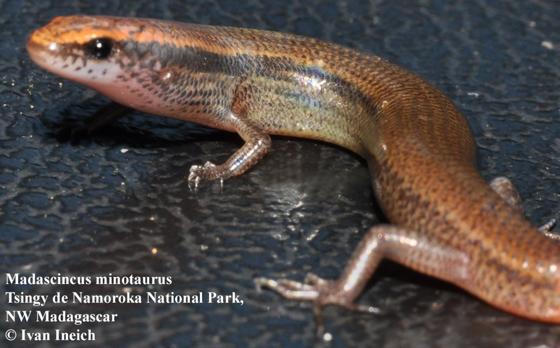
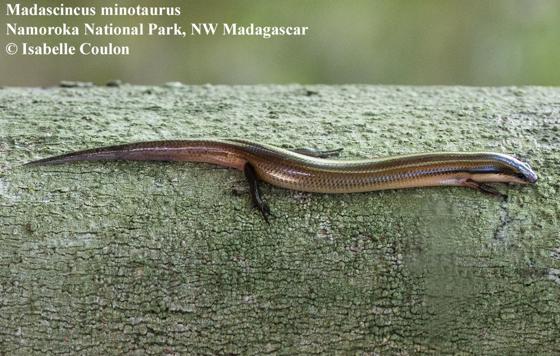

Can you confirm these amateur observations of Madascincus minotaurus?
Madascincus minotaurus
Find more photos by Google images search: 
| Higher Taxa | Scincidae, Scincinae, Scincoidea, Sauria, Squamata (lizards) |
| Subspecies | |
| Common Names | E: Not given |
| Synonym | Madascincus minotaurus MIRALLES, SCHERZ, ROBERTS, RAKOTOARISON, GLAW & VENCES 2026: 141 |
| Distribution | Madagascar (Only known from the Tsingy area of the Namoroka National Park, North West of Madagascar, and probably distributed all over this karstic massif and surrounding patches of deciduous forest. The holotype was collected at the border of the Petit Tsingy (eastern part of the Namoroka massif), at the limit between the rock corridor and the adjacent dry deciduous forested area. The sample MIRZC 1217 was found on the border of the Grand Tsingy in the southern part of the massif). Type locality: MADAGASCAR, Boeny Region, Tsingy de Namoroka National Park, Petit Tsingy; 16°26’7”S, 45°22’6”E; 125 m a.s.l. |
| Reproduction | |
| Types | Holotype. ZSM 116/2023 (ZCMV 15819), 1 adult ♀; 08 Oct. 2023, 07:00–09:00 a.m.; A. Miralles, N.A. Rahagalala, A. Rakotoarison, D. Razafimanafo and A. Razafimanantsoa leg. |
| Diagnosis | Diagnosis: Madascincus minotaurus sp. nov. differs from all other species in the genus Madascincus by the combination of a lower number of scales around midbody and a higher number of ventrals. It differs from the species of the melanopleura group (its sister clade formed by M. melanopleura, M. ankodabensis and M. minutus) by a distinctly higher number of ventrals (68, versus 55 to 63) and paravertebral scales (69, versus 51 to 65), by a bell-shaped frontal scale (versus hourglass-shaped, i.e., frontal constricted by the first pair of supraoculars) and a distinct, lighter and warmer coloration (versus darker and brownish). (Miralles et al. 2026) Unfortunately we had to temporarily remove additional information as this was scraped by multiple AI companies who sell that data. However, these details, e.g. detailed descriptions (about about 2.15 pages) are available for collaborators and contributors. Please contact us if you need any of this material. |
| Comment | Distribution: see map in Miralles et al. 2026: 148 (Fig. 9) |
| Etymology | The specific epithet minotaurus, invariable noun in apposition, is derived from Minṓtauros (ancient Greek: Μινώταυρος), a taurine creature of the Greek mythology. It alludes to the labyrinthine structure of the Tsingy de Namoroka, within which the new species, like the Minotaur in Daedalus’s construction, appears unable to escape. |
| References |
|
| External links |