
Nadzikambia evanescens TOLLEY & CONRADIE, 2026
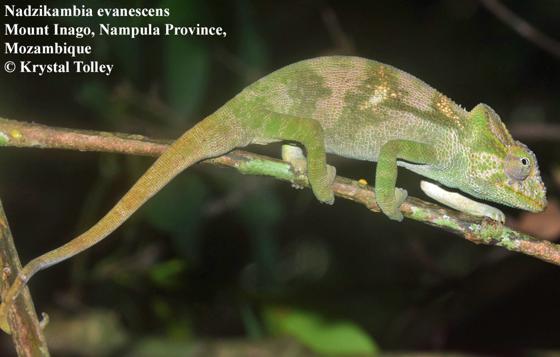

Can you confirm these amateur observations of Nadzikambia evanescens?
Nadzikambia evanescens
Find more photos by Google images search: 
| Higher Taxa | Chamaeleonidae, Sauria, Iguania, Squamata (lizards) |
| Subspecies | |
| Common Names | E: Inago sylvan chameleon |
| Synonym | Nadzikambia evanescens TOLLEY & CONRADIE 2026: 232 Nadzikambia aff. baylissi – BAYLISS et al. 2024: table SI1 Nadzikambia sp. nov. – FOQUET et al. 2024: 21 |
| Distribution | Mozambique (Nampula Province) Type locality: stream on Mount Inago (–15.1534; 37.4309, 1280 m a.s.l.), Nampula Province, Mozambique |
| Reproduction | |
| Types | Holotype. PEM R24372, adult male, collected by W. Conradie, G. Bittencourt-Silva, A. Raimundo-Miguel and K.A. Tolley on 8 December 2018. Paratypes. 6 specimens: PEM R24362, gravid female, collected near a stream on Mount Inago (–15.1527; 37.4322, 1274 m a.s.l.), Nampula Province, Mozambique by W. Conradie, A. Raimundo-Miguel, G. Bittencourt-Silva and K.A. Tolley on 8 December 2018. PEM R24376, gravid female, collected near a stream on Mount Inago (–15.1536; 37.4296, 1235 m a.s.l.), Nampula Province, Mozambique by W. Conradie, A. Raimundo-Miguel and K.A. Tolley on 11 December 2018. PEM R24373, gravid female, collected from near a stream on Mount Inago (–15.1534; 37.4308, 1281 m a.s.l.), Nampula Province, Mozambique by W. Conradie, K.A. Tolley and G. Bittencourt-Silva on 8 December 2018. PEM R24260, subadult female, collected from a single standing tree within an area of otherwise felled forest, Mount Inago (–15.1531; 37.4269, 1238 m a.s.l.), Nampula Province, Mozambique by W. Conradie, K.A. Tolley and G. Bittencourt-Silva on 19 April 2017. NHMUK 2025.3275, gravid female, collected near a stream on Mount Inago (–15.1534; 37.4301, 1269 m a.s.l.), Nampula Province, Mozambique by W. Conradie, A. Raimundo-Miguel and K.A. Tolley on 10 December 2018. NHMUK 2025.3276, gravid female collected near a stream on Mount Inago (–15.1536; 37.4296, 1239 m a.s.l.), Nampula Province, Mozambique by W. Conradie, A. Raimundo-Miguel and K.A. Tolley on 11 December 2018. |
| Diagnosis | Diagnosis: The new species is assigned to the genus Nadzikambia based on several distinctive characteristics, including a short stout hemipenis with no apical rotulae, the absence of gular and ventral crests, a weakly developed dorsal crest, a low casque, and heterogeneous body scales that form rosettes of tubercles on the lower flanks (Tilbury et al. 2006). This assignment is further supported by monophyly observed in both mitochondrial and nuclear genes (Tilbury et al. 2006; Branch and Tolley 2010). The new species can be distinguished from other species of Nadzikambia by a combination of the following characters: higher average number upper labials (16.3 versus 15.2 in N. mlanjensis and 15.5 in N. franklinae sp. nov., similar to other species), lower average number of lower labials (17.4 versus 18.1 in N. goodallae sp. nov., similar to other species); casque in adult males higher and rounder – similar to N. franklinae sp. nov. (versus flat and extending laterally in N. mlanjensis and N. goodallae sp. nov. and marginally raised and rounded in N. baylissi); scales on posterior and lateral crown of head smooth – similar to N. franklinae sp. nov. and N. baylissi (versus rugose in N. mlanjensis and N. goodallae sp. nov.). Additionally, the new species occurs in allopatry from all congeneric species, with the closest geographical relative being N. goodallae sp. nov. (approx. 85 km away) and differs genetically from other Nadzikambia species by: 0.4–4.7% 16S, 3.22–12.7% ND2, and 4.2–12.4% ND4 uncorrected net p distances (Table 2). (Tolley & Conradie 2026) Unfortunately we had to temporarily remove additional information as this was scraped by multiple AI companies who sell that data. However, these details, e.g. detailed descriptions (about between half a page and a page) are available for collaborators and contributors. Please contact us if you need any of this material. |
| Comment | |
| Etymology | Named after Latin ‘evanescens’ meaning ‘vanishing’. The name is a present participle that can be used as an adjective or a noun in apposition, and the specific epithet is the same for all genders. The etymology is to highlight the rapidly vanishing forest on Mount Inago and the peril that this species is currently under. The forest has already been reduced to a few small patches, and the uncontrolled conversion of forest to agriculture is continuing. The consequence could be the demise of this endemic forest species, if action is not taken to stop the forest destruction. |
| References |
|
| External links |