
Nadzikambia nubila TOLLEY & CONRADIE, 2026
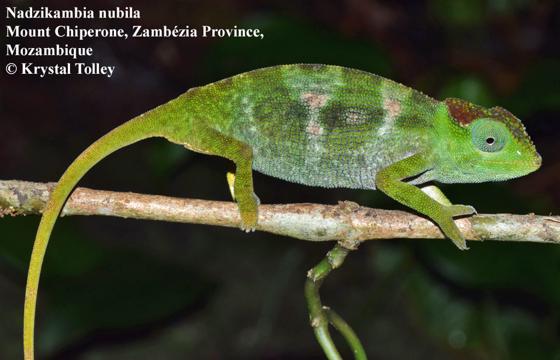

Can you confirm these amateur observations of Nadzikambia nubila?
Nadzikambia nubila
Find more photos by Google images search: 
| Higher Taxa | Chamaeleonidae, Sauria, Iguania, Squamata (lizards) |
| Subspecies | |
| Common Names | E: Chiperone sylvan chameleon |
| Synonym | Nadzikambia nubila TOLLEY & CONRADIE 2026: 235 Nadzikambia aff. baylissi – BAYLISS et al. (2024: table SI1) |
| Distribution | Mozambique (Zambézia Province) Type locality: stream on Mount Chiperone (–16.5070; 35.7258, 1045 m a.s.l.), Zambézia Province, Mozambique |
| Reproduction | |
| Types | Holotype. PEM R24249, adult female, collected by W. Conradie, G. Bittencourt-Silva, S. Loader and K.A. Tolley on 7 April 2017. Paratypes. (4 specimens). PEM R24245, adult female, collected by a stream on Mount Chiperone (–16.5072; 35.7258, 1017 m a.s.l.), Zambézia Province, Mozambique by W. Conradie, G. Bittencourt-Silva, S. Loader, and K.A. Tolley on 5 April 2017. PEM R24250, gravid female, collected by a stream on Mount Chiperone (–16.5080; 35.7248, 1021 m a.s.l.), Zambézia Province, Mozambique by W. Conradie, G. Bittencourt-Silva, S. Loader and K.A. Tolley on 8 April 2017. NHMUK 2025.3277, gravid female, collected near a stream on Mount Chiperone (–16.5066; 35.7260, 1053 m a.s.l.), Zambézia Province, Mozambique by W. Conradie, G. Bittencourt-Silva, S. Loader and K.A. Tolley on 7 April 2017. NHMUK 2025.3278, adult female, collected by a stream on Mount Chiperone (–16.508; 35.7248, 1020 m a.s.l.), Zambézia Province, Mozambique by W. Conradie, G. Bittencourt-Silva, S. Loader and K.A. Tolley on 7 April 2017. |
| Diagnosis | Diagnosis: The new species is assigned to the genus Nadzikambia based on several distinctive characteristics, including the absence of gular and ventral crests, a weakly developed dorsal crest, a low casque, and heterogeneous body scales that form rosettes of tubercles on the lower flanks (Tilbury et al. 2006). This assignment is further supported by monophyly observed in both mitochondrial and nuclear genes (Tilbury et al. 2006; Branch and Tolley 2010). Due to the lack of males in the type series this species cannot be compared to the male holotypes of other species. The new species can be distinguished from other species of Nadzikambia by a combination of the following characters: higher average number upper labials (16.6 versus 15.2 in N. mlanjensis and 15.5 in N. franklinae sp. nov., similar to other species), and lower average number of lower labials (17.4 versus 18.1 in N. goodallae sp. nov., similar to other species). Additionally, the new species occurs in allopatry from all congeneric species, with the closest geographical relative being N. mlanjensis (approx. 65 km away) and differs genetically from other Nadzikambia species by: 0.7–4.7% 16S, 1.7–12.7% ND2, and 4.7–11.5% ND4 uncorrected net p distances (Table 2). (Tolley & Conradie 2026) Holotype description. Adult female male (64.7 mm SVL + 78.0 TL = 142.7 mm total length). The specimen has a single ventral incision in the chest region for tissue sample extraction. Head short (HL/SVL = 0.29) and narrow (HW = 8.6 mm), distance from tip of snout to the superior edge of the casque is twice the width of the head (HL/HW = 2.21). The casque is slightly elevated above the nape, elongated, and its posterior apex points backward to a rounded rim. The crown of the head is flattened both anteriorly and posteriorly. It is depressed centrally and laterally relative to the parietal crest. The dorsal surface bears flattened, smooth scales, except along the parietal crest itself, and these abut one another with a few smaller interspersed granules. The largest scales occur along the midline of the snout, adjacent to the parietal crest, and alongside the lateral and supraorbital crests. Six scales are present between the supraorbital crests at mid-orbit. A reduced parietal crest is present on the crown, composed of three moderately raised, enlarged, smooth scales that increase in size posteriorly. The crown is bordered on both sides by raised tubercles of the lateral and supraorbital crests and at the rear by the casque. The temporal crest is absent. The lateral crest consists of 8/9 (right/left) raised, irregular tubercular scales that arise from the mid-upperrim of the orbit and curve upward around the casque. Thesupraorbital crest extends from the lateral crest at the upper posterior rim of the orbit, continuing forward over theeye and onto the snout. It is composed of a series of 14/13raised scales. The canthus rostralis not elevated to formany protrusions or ‘horns’. Three to four rows of smallerscales separate the canthi from the upper labials on thesnout. The orbit is separated from the upper labials by oneto two rows of small granules. Scales around the eye areelongated, longer than wide, with nine scales above and10 below the orbit. The nostril is rhombic, posteriorly directed, and positioned midway between the tip of the snout and the front of the orbit. It is separated from the upper labials by three rows of granules, with the scales in direct contact with the nostril much smaller than the larger ones in contact with the upper labials. The nostril is also separated from the orbit by three rows of scales and from the supraorbital crest by two rows of scales. No enlarged rostral or mental scales are present. The upper labials (17/17) are sub-hexagonal and subequal in size, with the largest scales located from the snout to the posterior rim of the eye; scales at the rictus are smaller and more rounded. The lower labials (19/18) are similarly sub-hexagonal and subequal in size, with the largest scales extending from the snout to the posterior rim of the eye; scales at the rictus are also smaller and more rounded. Scales bordering the lower labials are irregularly shaped and subequal in size to the lower labials. Gular grooves are fine and inconspicuous. Gular scales are round and raised, with the smallest scales located centrally and increasing in size toward the lower labials. The dorsal crest is mostly absent, except for five slightly raised scales anteriorly. A ventral crest is absent. Body scales are relatively homogeneous and flattened, abutting one another and forming rosettes on the lower flanks. No smaller granules between scales on the flanks. The smallest scales are located on the belly and are more conical in shape, while the largest, squarish scales are found along the flanks and the paravertebral zone. Scales on the limbs are homogeneous and rounded, with the largest scales located on the outer surfaces of the hindlimbs and forelimbs. Soles of hindfeet and forefeet with closely fit smooth round scales. Scales above digits heterogenous, larger posteriorly getting smaller anteriorly. Scales under digits slightly larger than those on the soles and more elongated. The scales on the digits directly adjacent to the claws are enlarged, followed by a similarly sized scale that is occasionally split into two. The tail is longer than the body (TL/SVL = 1.21), dorso-ventrally flattened, and tapering distally to a fine tip. The dorsal and lateral scales are squarish and larger than the more rounded ventral scales. (Tolley & Conradie 2026) Unfortunately we had to temporarily remove additional information as this was scraped by multiple AI companies who sell that data. However, these details, e.g. detailed descriptions (about about 2.53 pages) are available for collaborators and contributors. Please contact us if you need any of this material. |
| Comment | |
| Etymology | Named after Latin ‘nubilus’ meaning “cloudy,” and is modified to the feminine form to agree with the feminine gender of the genus Nadzikambia. The common name is derived from the “Ciperoni” – the term used locally for the weather that brings heavy clouds and orographic rainfall to the area. The cloud sustains the mid-elevation wet forest on this mountain. |
| References |
|
| External links |