
Pholidobolus dicrus (UZZELL, 1973)
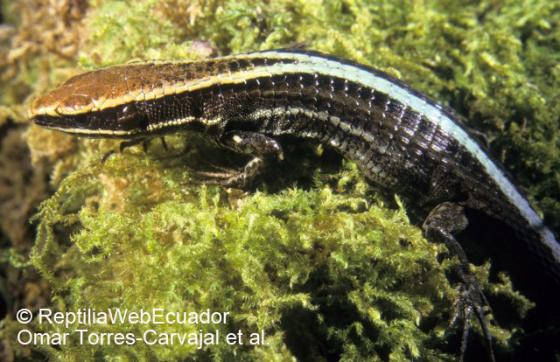

Can you confirm these amateur observations of Pholidobolus dicrus?
Pholidobolus dicrus
Find more photos by Google images search: 
| Higher Taxa | Gymnophthalmidae (Cercosaurinae), Sauria, Gymnophthalmoidea, Squamata (lizards) |
| Subspecies | |
| Common Names | E: Uzzell's Prionodactylus |
| Synonym | Prionodactylus dicrus UZZELL 1973: 19 Prionodactylus dicrus — TORRES-CARVAJAL 2001 Cercosaura dicra — DOAN 2003 Pholidobolus dicrus — TORRES-CARVAJAL et al. 2015 Cercosaura dicrus — PYRON & BURBRINK 2013 |
| Distribution | C Ecuador (Eastern Andean slopes) Type locality: Ecuador, Tungurahua, Mapoto, 1300 m Elevation: 600–1800 m (DOAN & LAMAR 2012). |
| Reproduction | oviparous |
| Types | Holotype: FMNH 36708, adult female; PARATYPES. FMNH 28043, 134152, USNM 193592: Ecuador, Tungurahua, Baños (1800 m); BMNH 1912.11.1.34: Topo (1500 m); AMNH 24144, CAS-SU 8253: Pastaza, Abitagua (1100-1500 m) ; USNM 193590-91 : headwaters of Río Arajuno (about 600 m); USNM 194383: between Baños and Puyo (900 m). |
| Diagnosis | DIAGNOSIS (n=10). A member of the genus Prionodactylus closely allied to P. vertebralis in having an undivided frontonasal and the loreal scale separated from the upper labial scales by contact between the nasal and frenoocular; these two features distinguish P. vertebralis and P. dicrus from all other species of the genus. P. dicrus differs from P. vertebralis in that it has two light lines on the snout, superciliary scales and anterior parts of the body that fuse posteriorly to form a median light line, rather than a median light line from the snout to the tail; and marked sexual dimorphism in femoral pore number (20-25 in males of P. dicrus, 7-11 females; 0-16 in males and females of P. vertebralis. Subdigital lamellae of forefoot without tubercles (Fig. 7). (Uzzell 1973) Unfortunately we had to temporarily remove additional information as this was scraped by multiple AI companies who sell that data. However, these details, e.g. detailed descriptions (about about 2.44 pages) are available for collaborators and contributors. Please contact us if you need any of this material. |
| Comment | |
| Etymology | Named after Greek dikros (δίκρος), forked, split, double. [“...The name is from the Greek δίκρος, forked. It is used as an adjective modifying Prionodactylus...”]. (from Esteban Lavilla, pers. comm., May 2024) |
| References |
|
| External links |