You are here » home › advanced search › search results › Pseudonaja aspidorhyncha

Pseudonaja aspidorhyncha (MCCOY, 1879)
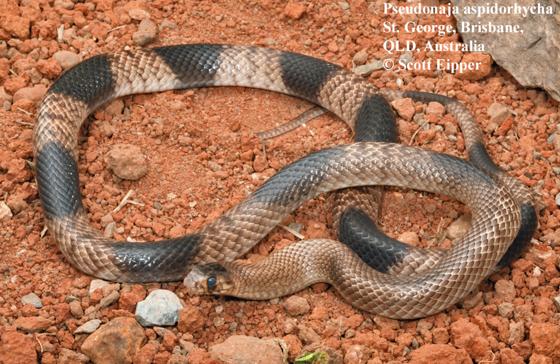
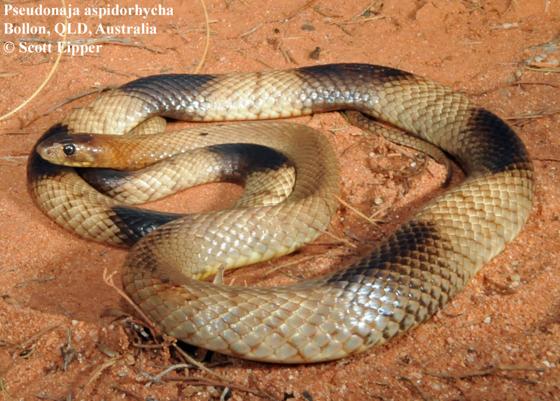
Can you confirm these amateur observations of Pseudonaja aspidorhyncha?

Add your own observation of
Pseudonaja aspidorhyncha »

Find more photos by Google images search: Google images

Higher TaxaElapidae (Hydrophiinae), Elapoidea, Caenophidia, Alethinophidia, Serpentes, Squamata (snakes)
Subspecies 
Common Names 
SynonymDiemenia aspidorhyncha MCCOY 1879: 13
Diemenia carinata LONGMAN 1915: 31
Demansia acutirostris MITCHELL 1951 (part.)
Demansia carinata — MITCHELL 1955: 378
Pseudonaja gowi WELLS 2002
Pseudonaja aspidorhyncha — WELLS 2002
Pseudonaja carinata — WELLS 2002
Pseudonaja aspidorhyncha — SKINNER 2009
Pseudonaja aspidorhyncha — WALLACH et al. 2014: 604
Pseudonaja aspidorhyncha — MIRTSCHIN et al. 2017
Pseudonaja aspidorhyncha — EIPPER & EIPPER 2024: 192 
DistributionSouthern central Australia, south of 27°S, from Penong, western Eyre Peninsula, to Hermidale, central New South Wales.

Type locality: from unstated locality; Vic. by implication, restricted to junction of Murray and Darling Rivera by Coventry (1970).  
Reproductionoviparous (not imputed, fide Zimin et al. 2022) 
TypesHolotype: NMV D12352
Holotype: QM J1508 [carinata]
Holotype: SAMA R3133 [acutirostris] 
DiagnosisDiagnosis: Pseudonaja aspidorhyncha may be differentiated from the remaining species of Pseudonaja redescribed here except P. nuchalis in possessing a strap-like rostral that imparts a chisel shape to the snout from a dorsal perspective (see Fig. 1). A diploid chromosome number of 34 serves to distinguish P. aspidorhyncha from the remaining species of Pseudonaja except P. affinis and possibly P. mengdeni (see Skinner et al., 2005, and below). The relative length of the prefrontal suture (i.e. the length of the prefrontal suture divided by head length) is consistently lower than for P. textilis specimens (0.049–0.092 vs. 0.096–0.136; see Table 9). Pseudonaja aspidorhyncha is separable from P. mengdeni and P. nuchalis in displaying (when preserved) a whitish to pale grey (as opposed to predominantly dark bluish grey) buccal epithelium (in live specimens, the buccal epithelium is never black as in P. mengdeni and P. nuchalis), and usually exhibits a greater number of ventrals than P. inframacula and P. nuchalis. (SKINNER 2009)


Unfortunately we had to temporarily remove additional information as this was scraped by multiple AI companies who sell that data. However, these details, e.g. detailed descriptions (about less than half a page) are available for collaborators and contributors. Please contact us if you need any of this material. 
CommentVenomous!

Karyotype: Mengden (1985) reported a diploid chromosome number of 34, with autosome pairs 4–16 being separable into two distinct size classes, and sex chromosomes that are of equal size.

Reference images: see Uetz et al. 2024 for high-resolution reference images for this species. 
EtymologyPresumably named after the Greek aspidos (shield) + rhynchos (ῥύγχος) (snout) in reference to the enlarged rostral shield. (G. Shea, pers. comm., 9 Feb 2024) 
References
  • Cogger, H. G. 2014. Reptiles and Amphibians of Australia, 7th ed. CSIRO Publishing, xxx + 1033 pp. - get paper here
  • Eipper T & Eipper S 2024. SNAKES OF AUSTRALIA. Princeton University Press, Princeton and Oxford, 368 pp. - get paper here
  • Jolly, C., Schembri, B., & Macdonald, S. 2023. Field Guide to the Reptiles of the Northern Territory. CSIRO Publishing, Melbourne - get paper here
  • Kaiser, H.; Crother, B.I.; Kelly, C.M.R.; Luiselli, L.; O’Shea, M.; Ota, H.; Passos, P.; Schleip, W.D. & Wüster, W. 2013. Best Practices: In the 21st Century, Taxonomic Decisions in Herpetology are Acceptable Only When Supported by a Body of Evidence and Published via Peer-Review. Herpetological Review 44 (1): 8-23
  • Longman, H. A. 1915. Reptiles from Queensland and the Northern Territory. Memoirs of the Queensland Museum 3: 30-34. - get paper here
  • McCoy, F. 1879. Diemenia superciliosa (Fischer) The common brown snake; Diemenia microlepidota (McCoy) Small-scaled brown snake, Diemenia aspidorhyncha (McCoy) The shield-fronted brown snake. [...] Prod. Zool. Vict. 3: 11-13. - get paper here
  • Mirtschin, P., Rasmussen, A.R. & Weinstein, S.A. 2017. Australia’s Dangerous snakes. CSIRO Publishing, 424 pp. - get paper here
  • Mitchell, F. J. 1951. The South Australian Reptile Fauna. Part. 1. Ophidia. Rec. South Austral. Mus. 9: 545—557. - get paper here
  • Mitchell, F. J. 1955. Preliminary account of the Reptilia and Amphibia collected by the National Geographic Society - Commonwealth Government - Smithsonian Institution Expedition to Arnhem Land (April to November, 1948). Rec. South Austral. Mus. 11: 373-408 - get paper here
  • Skinner, Adam 2009. A multivariate morphometric analysis and systematic review of Pseudonaja (Serpentes, Elapidae, Hydrophiinae). Zoological Journal of the Linnean Society 155 (1): 171-197 - get paper here
  • Swan, G.; Sadlier, R.; Shea, G. 2017. A field guide to reptiles of New South Wales. Reed New Holland, 328 pp.
  • Uetz, P.H.; Patel, M.; Gbadamosi, Z.; Nguyen, A.; Shoope, S. 2024. A Reference Database of Reptile Images. Taxonomy 4: 723–732 - get paper here
  • Wallach, Van; Kenneth L. Williams, Jeff Boundy 2014. Snakes of the World: A Catalogue of Living and Extinct Species. [type catalogue] Taylor and Francis, CRC Press, 1237 pp.
  • Wells, Richard W. 2002. Taxonomy of the Genus Pseudonaja (Reptilia: Elapidae) in Australia. Australian Biodiversity Record (7): 1-41
  • Wilson, S. & Swan, G. 2010. A complete guide to reptiles of Australia, 3rd ed. Chatswood: New Holland, 558 pp.
  • Zimin, A., Zimin, S. V., Shine, R., Avila, L., Bauer, A., Böhm, M., Brown, R., Barki, G., de Oliveira Caetano, G. H., Castro Herrera, F., Chapple, D. G., Chirio, L., Colli, G. R., Doan, T. M., Glaw, F., Grismer, L. L., Itescu, Y., Kraus, F., LeBreton 2022. A global analysis of viviparity in squamates highlights its prevalence in cold climates. Global Ecology and Biogeography, 00, 1–16 - get paper here
 
External links  
Is it interesting? Share with others:


Please submit feedback about this entry to the curator
