You are here » home › search results › Rhadinella serperaster

Rhadinella serperaster (COPE, 1871)

IUCN Red List - Rhadinella serperaster - Least Concern, LC

Can you confirm these amateur observations of Rhadinella serperaster?

Add your own observation of
Rhadinella serperaster »

Find more photos by Google images search: Google images

Higher TaxaColubridae (Dipsadinae), Colubroidea, Caenophidia, Alethinophidia, Serpentes, Squamata (snakes)
Subspecies 
Common Names 
SynonymRhadinaea serperaster COPE 1871: 212
Rhadinaea serperastra — BOULENGER 1894: 172
Rhadinaea serperastra — TAYLOR 1951: 112
Rhadinaea serperaster — PETERS & OREJAS-MIRANDA 1970: 268
Rhadinaea serperaster — MYERS 1974: 150
Rhadinaea serperaster — VILLA et al. 1988
Rhadinaea serperaster — SAVAGE 2002: 626
Rhadinaea serperastra (fide HAGEDORN, pers. comm.)
Rhadinella serperaster — MYERS 2011
Rhadinella serperaster — WALLACH et al. 2014: 644
Rhadinella serperaster — CURLIS et al. 2020 
DistributionCosta Rica, elevation 1220-1450 meters (Myers 1974)

Type locality: Costa Rica, San Jose.  
Reproductionoviparous 
TypesHolotype: ANSP 3739, juvenile male 
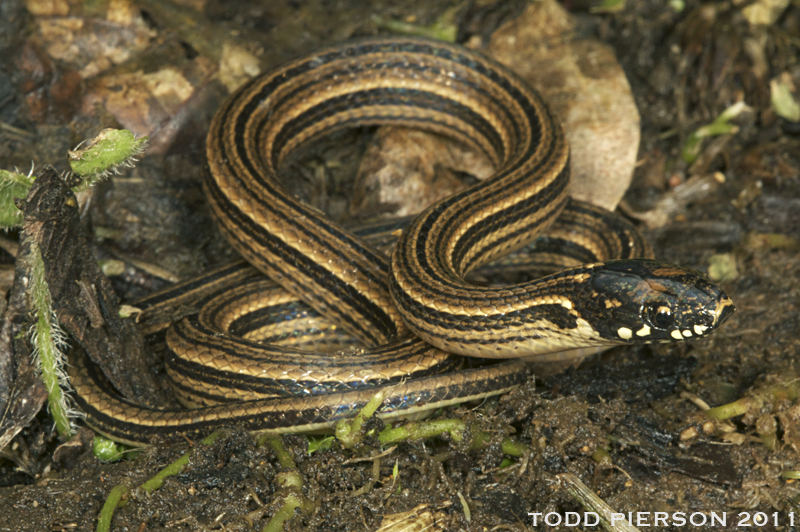
DiagnosisDiagnosis: Rhadinaea serperaster differs from all other species of the genus, except the geographically distant R. hempsteadae and R. montecristi, in having 19-19-19 rows of scales. Rhadinaea serperaster has a complex pattern of body stripes that differs markedly from hempsteadae and montecristi (see fig. 28). However, the pattern of serperaster is nearly identical with that of individuals of some possibly sympatric populations of R. godmani, which is most easily differentiated by its greater number (21) of scale rows. (Myers 1974: 150)


Unfortunately we had to temporarily remove additional information as this was scraped by multiple AI companies who sell that data. However, these details, e.g. detailed descriptions (about about 2.53 pages) are available for collaborators and contributors. Please contact us if you need any of this material. 
CommentDistribution: all records of Rhadinaea serperaster from Panama (e.g., Dunn 1947) are based on misidentified specimens of the similar Rhadinella godmani, which appears to be endemic to Costa Rica (Savage 2002, S. Lotzkat, pers. comm., 23 Dec 2014).

Similar species: Rhadinaea serperaster greatly resembles specimens of the southern form of R. godmani, and a few references to serperaster are based entirely (Dunn, 1947) or partly (Stuart and Bailey, 1941: 7) on specimens of godmani.

Habitat: Three small specimens of Rhadinaea serperaster were found under moss on logs and in an earthen bank in a cafetal (William E. Duellman, field notes for KU 103895-103897, cited in Myeres 1974). 
EtymologyNamed after Latin serperastra, knee-splints, knee-bandages (to straighten the legs of children). [“...Dark brown, with six longitudinal yellow or white lines...”]. 
References
  • Acosta-Chaves, Víctor J.; Gerardo Chaves, Juan G. Abarca, Adrián García-Rodríguez, Federico Bolaños 2015. A checklist of the amphibians and reptiles of Río Macho Biological Station, Provincia de Cartago, Costa Rica. Check List 11 (6): 1784 - get paper here
  • Boulenger, George A. 1894. Catalogue of the snakes in the British Museum (Natural History). Volume II., Containing the Conclusion of the Colubridæ Aglyphæ. British Mus. (Nat. Hist.), London, xi, 382 pp. - get paper here
  • Cope, E.D. 1871. Ninth contribution to the herpetology of tropical America. Proc. Acad. Nat. Sci. Philadelphia 23: 200-224 - get paper here
  • Curlis JD, Fisher EC, Muhic WK, Moy J, Garro-Cruz M, Montero-Ramírez JJ 2020. A survey of the reptiles and amphibians at the University of Georgia Costa Rica field station in San Luis de Monteverde, Costa Rica. Check List 16(6): 1433-1456 - get paper here
  • Köhler, G. 2008. Reptiles of Central America. 2nd Ed. Herpeton-Verlag, 400 pp.
  • López-Goñi, X., Bonilla, F., & Sasa, M. 2025. Spatial Distribution of a Community of Fossorial Snakes of the Genus Geophis (Serpentes: Dipsadidae) in the Central Cordillera of Costa Rica. Journal of Herpetology, 59(3): 179-188 - get paper here
  • Myers, C.W. 1974. The systematics of Rhadinaea (Colubridae), a genus of New World snakes. Bull. Amer. Mus. nat. Hist. 153 (1): 1-262 - get paper here
  • Myers, Charles W. 2011. A New Genus and New Tribe for Enicognathus melanauchen Jan, 1863, a Neglected South American Snake (Colubridae: Xenodontinae), with Taxonomic Notes on Some Dipsadinae. American Museum Novitates (3715): 1-33 - get paper here
  • O’Shea, M. 2018. The Book of Snakes. Ivy Press / Quarto Publishing, London, - get paper here
  • Sasa, M., Arias, E., & Chaves, G. 2025. Annotated list of amphibians and reptiles of Costa Rica: The role of the Museum of Zoology in cataloging the country’s herpetological diversity. Revista de Biología Tropical, 73(S2): e64536-e64536 - get paper here
  • Savage, J.M. 2002. The Amphibians and Reptiles of Costa Rica: A Herpetofauna Between Two Continents, Between Two Seas. University of Chicago Press, 934 pp. [review in Copeia 2003 (1): 205]
  • Solorzano, A. 2004. Serpientes de Costa Rica - Snakes of Costa Rica. Editorial INBio, Costa Rica, 792 pp.
  • Taylor,E.H. 1951. A brief review ot the snakes of Costa Rica. Univ. Kansas Sci. Bull. 34 (1): 3-188 - get paper here
  • Taylor,E.H. 1954. Further studies on the serpents of Costa Rica. Univ. Kansas Sci. Bull. 36: 673-800. - get paper here
  • Villa, J., Wilson, L.D., Johnson, J.D. 1988. Middle American Herpetology - A Bibliographic Checklist. University of Missouri Press, 132 pp [review in Copeia 1989 (3): 802]
  • Wallach, Van; Kenneth L. Williams, Jeff Boundy 2014. Snakes of the World: A Catalogue of Living and Extinct Species. [type catalogue] Taylor and Francis, CRC Press, 1237 pp.
 
External links  
Is it interesting? Share with others:


Please submit feedback about this entry to the curator