
Rhadinella xerophila ARIANO-SÁNCHEZ & CAMPBELL, 2018
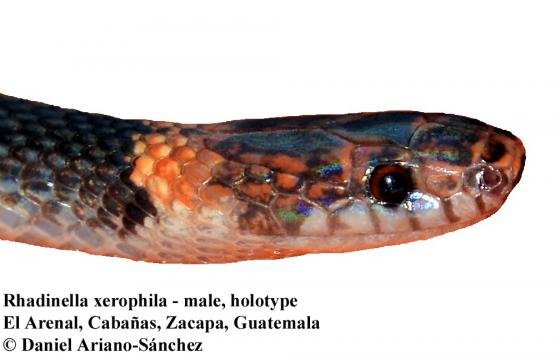
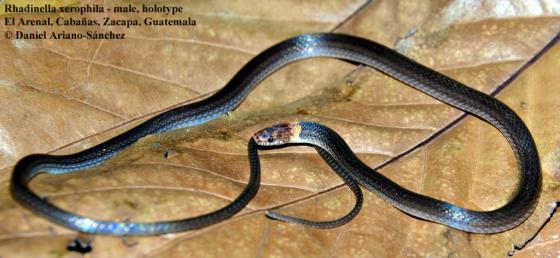

Can you confirm these amateur observations of Rhadinella xerophila?
Rhadinella xerophila
Find more photos by Google images search: 
| Higher Taxa | Colubridae (Dipsadinae), Colubroidea, Caenophidia, Alethinophidia, Serpentes, Squamata (snakes) |
| Subspecies | |
| Common Names | |
| Synonym | Rhadinella xerophila ARIANO-SÁNCHEZ & CAMPBELL 2018 |
| Distribution | SE Guatemala Type locality: northern limit of Heloderma Natural Reserve (HNR) at El Arenal (14.868878 N, 89.790526 W; 580 m above sea level, asl hereafter), Cabañas, Zacapa, Guatemala |
| Reproduction | |
| Types | Holotype. UVG R-7003, adult male, collected on 29 October 2016 by D. Ariano-Sánchez. |
| Diagnosis | Diagnosis: Small, slender and gracile snake of genus Rhadinella, which can be distinguished from the other congeners by the following unique combination of characters: head only slightly distinct from neck; inverted dark U-shaped marking on rostral; anterior supralabials with dark edges and pale centers; conspicuous orange collar on neck divided at mid-dorsum, extending 3.5 scale lengths at mid-dorsum and three scale lengths on side of head, posterior to ultimate supralabial; no subpreocular scale; no broad diastema; temporals 1 + 2; dorsal scale rows 17, smooth, unreduced throughout body; ventrals 158; cloacal scute divided; tail complete, subcaudals 116, divided; dorsal coloration dark gray to blackish, almost totally obfuscating longitudinal striping, ground color not extending to lateral edges of ventrals. Unfortunately we had to temporarily remove additional information as this was scraped by multiple AI companies who sell that data to their customers. These details, e.g. detailed descriptions or comparisons (about 1968 characters) are available for collaborators and contributors. Please contact us for details. |
| Comment | Habitat: The holotype was found active crawling on sandy soil in a dry gully at approximately 19:30 h. The landscape is composed of patches of seasonally dry tropical forest and tropical thorn scrub, within a matrix of cornfields and melon crops. Most of the topography is undulating, with steep slopes (Fig. 1B). The vegetation includes such distinctive dry forest species as Bursera excelsa (Burseraceae), Nopalea guatemalensis (Cactaceae), Pilosocereus leucocephalus (Cactaceae), Stenocereus pruinosus (Cactaceae), Leucaena collinsii (Mimosaceae), Lysiloma divaricatum (Mimosaceae), Bucida macrostachya (Combretaceae), and Bonellia macrocarpa (Theophrastaceae). Sympatry: Ctenosaura palearis (Stejneger 1899) and Heloderma charlesbogerti (Campbell & Vannini 1988). Distribution: see map in ARIANO-SÁNCHEZ & CAMPBELL 2018: 342 (Fig. 3). |
| References |
|
| External links |