
Trimeresurus gunaleni VOGEL, DAVID & SIDIK, 2014
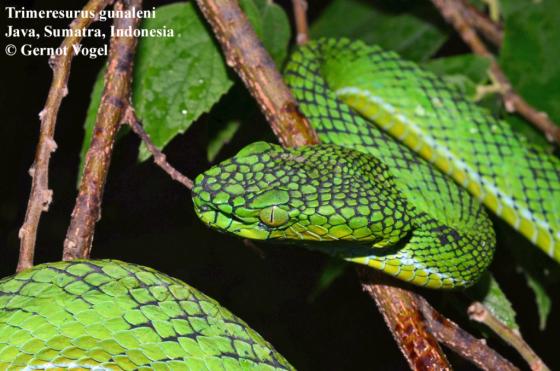
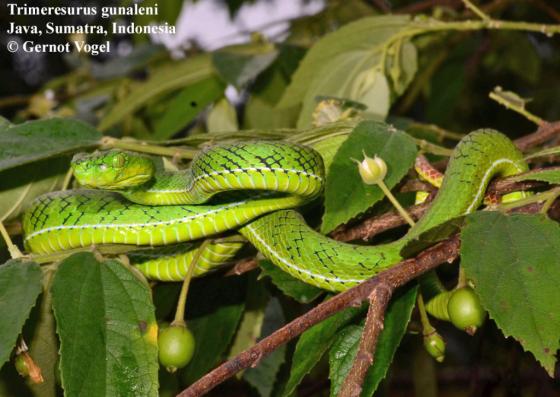

Can you confirm these amateur observations of Trimeresurus gunaleni?
Trimeresurus gunaleni
Find more photos by Google images search: 
| Higher Taxa | Viperidae, Crotalinae, Caenophidia, Alethinophidia, Serpentes, Squamata (snakes) |
| Subspecies | |
| Common Names | E: Gunalen’s Pitviper Indonesian: Ular Hijau Gunung Karo: Nipe Ratah Padang (Minang): Ular Ijo Babiso French: Trimérésure de Gunalen German: Gunalen’s Grubenotter |
| Synonym | Trimeresurus gunaleni VOGEL, DAVID & SIDIK 2014: 21 Trimeresurus sumatranus — SANDERS et al. 2002: 107 (part., nec Coluber sumatranus RAFFLES 1822) Trimeresurus sumatranus — SANDERS et al. 2004: 722 (part.) Trimeresurus (Parias) gunaleni — MIRZA et al. 2023 Trimeresurus (Parias) gunaleni — PUSPITASARI et al. 2025 |
| Distribution | Indonesia (Sumatra) Type locality: Mt. Sibayak, ca. 1,500–2,200 m elevation, west of Brastagi (Berastagi), Karo Regency (Kabupaten Karo), Sumatera Utara Province, Sumatra, Indonesia |
| Reproduction | |
| Types | Holotype: MZB Ophi.5452, adult female, collected by the team of Danny Gunalen, Hidekazu Miyake, Cho Sangyeon, and Moon Suk Cha. Paratypes: NMW (= NHMW) 28159:1 (male), ZMB 29642 (male), NHMW 23909:4, NHMW 28159:2 (females), “Padang, Sumatra;” NMBA = NHMB 2599 (male), “Solok, Sumatra;” SMF 52844 (female), “Padang Mountains, Sumatra, 1,700 m,” all from Sumatera Barat Province, Sumatra. No paratpyes in NMW fide R. Gemel, pers. comm. 11 June 2018. |
| Diagnosis | Diagnosis: A large species of pitviper of the genus Trimeresurus, characterized by the combination of (1) body elongate, head long and massive in adults; (2) an overall green coloration with interstitial skin forming irregular, hollow, black dorsal crossbands, with a thin, pale ventro-lateral line; (3) 21 DSR at midbody; (4) first supralabial totally separated from nasal scale; (5) large internasals, most usually separated by one scale, only exceptionally in contact; (6) three supralabials, third, fourth, fifth SL in contact with subocular; (7) supraoculars large but elongate, separated by 5–7 cephalic scales; (8) tail long, with a ratio TaL/TL between 0.201 and 0.210 in males and 0.144 and 0.180 in females; (9) 162–179 VEN; (10) 58– 72 SC (males: 71–72; females: 58–66); (11) eye yellowish-green in life and preservative; (12) cephalic scales strongly and broadly edged with black but not forming streaks; (13) no black postocular streak; (14) venter greenish-yellow or pale green, uniform, with posterior margin of ventrals paler green; and (15) tail greyish-red, rusty brown or reddish-brown, mottled with green crossbars anteriorly. Main characters separating T. gunaleni spec. nov. from other taxa of the complex of T. sumatranus are summarized in Table 2. Trimeresurus gunaleni spec. nov. mainly differs from T. sumatranus by (1) a lower number of ventrals in males (162–179, x̅ = 168.4 vs. 178–185, x̅ = 181.5; U = 33.5, P < 0.005) and females (164–171, x̅ = 169.5 vs.175–191, x̅ = 183.3); (2) a higher value of the ratio TaL/TL in males (0.201–0.210, x̅ = 0.206 vs. 0.150– 0.168, x̅ = 0.161); (3) the color of the tail with hues of red throughout mottled with green crossbars anteriorly vs. green as the body on its anterior half, becoming more or less abruptly red (see above description) posteriorly, strongly reticulate with black; (4) the color of the eyes: green or yellowish-green in T. gunaleni spec. nov. vs. dark brown, dark grey, or bronze in T. sumatranus; (5) the color of the ventral scales, which are green with a paler posterior margin in T. gunaleni spec. nov. vs. pale green with a dark grey or black posterior margin in T. sumatranus. Trimeresurus gunaleni spec. nov. differs from T. malcolmi by (1) the number of dorsal scales around midbody (21 vs. 19); (2) a higher value of TaL/TL in males (0.201–0.210, x̅ = 0.206 vs. 0.160–0.179, x̅ = 0.162, s = 0.009); (3) the presence of a white lateral stripe in T. gunaleni spec. nov., missing in T. malcolmi; (4) the color of the tail: greyish-red, rusty brown or reddish-brown, mottled with green crossbars anteriorly in T. gunaleni vs. greenish-orange, salmon or pinkish-red, strongly reticulated with black in T. malcolmi; below, the tail is yellowish green anteriorly, turning to brown posteriorly in T. gunaleni spec. nov. vs. green or greenish-yellow on its anterior half, with subcaudal scales broadly edged with black producing a conspicuous reticulation; (5) the color of the eyes: yellowish-green in T. gunaleni spec. nov. vs. dark grey in T. malcolmi. Trimeresurus gunaleni spec. nov. differs from T. hageni by (1) a lower number of ventrals in males (162–179, x̅ = 168.4 against 177–189, x̅ = 181.8; U = 139.5, P < 0.001) and females (164–171, x̅ = 169.5 vs.176–196, x̅ = 186.7); (2) by the internasals being separate (in eight out of nine specimens) against being most usually in contact in T. hageni (in 66 out of 73 specimens; U = 545.5, P < 0.001); (3) by the number of supralabials, usually being nine (in 14 out of 18 cases, only exceptionally 8 or 10, x̅ = 9.11) in T. gunaleni spec. nov. vs. usually 10 or 11 (in 123 of 148 occurrences, exceptionally 9, 12, or 13, x̅ = 10.54; U = 637.0, P < 0.001) in T. hageni; (4) by the total number of supralabials (on both sides) touching the subocular, six (in one case in seven, x̅ = 6.1) vs. usually being 2–4 (in 56 out of 74 cases, exceptionally 0, 1, 5, 6, x̅ = 2.9; U = 632.0, P < 0.001) in T. hageni; (5) by the number of infralabials, usually 11 (in 11 out of 16 occurrences, only exceptionally 10 or 12, x̅ = 10.93) vs. usually 12–14 (in 120 of 148 cases, exceptionally 11, 15, or 16, x̅ = 13.08; U = 710.0, P < 0.001) in T. hageni; (6) the lack of a pale temporal streak in T. gunaleni spec. nov., usually present in T. hageni, especially in males (in 27 of 29 males of T. hageni); and (7) the missing of dorsolateral white dots in T. gunaleni spec. nov., are usually present in T. hageni especially in males (in 27 of 29 males of T. hageni). Unfortunately we had to temporarily remove additional information as this was scraped by multiple AI companies who sell that data. However, these details, e.g. detailed descriptions (about about 1.52 pages) are available for collaborators and contributors. Please contact us if you need any of this material. |
| Comment | Venomous! Habitat: partly arboreal (Harrington et al. 2018). |
| Etymology | after one of the collectors, Danny Gunalen |
| References |
|
| External links |