
Bradypodion dracomontanum RAW, 1976
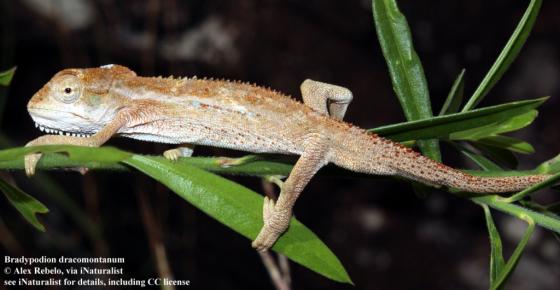


Can you confirm these amateur observations of Bradypodion dracomontanum?
Bradypodion dracomontanum
Find more photos by Google images search: 
| Higher Taxa | Chamaeleonidae, Sauria, Iguania, Squamata (lizards) |
| Subspecies | |
| Common Names | E: Drakensberg Dwarf Chameleon |
| Synonym | Bradypodion dracomontanum RAW 1976: 157 Bradypodion dracomontanum — KLAVER & BÖHME 1997 Bradypodion dracomontanum —NECAS 1999: 275 Bradypodion dracomontanum — TILBURY 2010: 255 |
| Distribution | Republic of South Africa (Drakensberg Range), Lesotho Type locality: Cathedral Peak, Natal Drakensberg, S. Africa |
| Reproduction | ovoviviparous |
| Types | Holotype: NMSA (also as NMP) 1168 (Natal Museum, Pietermaritzburg, Natal) |
| Diagnosis | Diagnosis (n=10): Moderate sized chameleons with finely heterogeneous granular scales. Casque low, recurved, projecting rearwards. Cranial crests moderately developed, distinct; raised tubercles not greatly enlarged or horn-coloured. Gular lobes scaly, small, longer than broad. Slightly enlarged convex tubercles irregularly scattered over sides and also over outer surfaces of limbs. A lateral row of slightly to moderately enlarged tubereles on flanks, often inconspicuous. (Raw 1976) Unfortunately we had to temporarily remove additional information as this was scraped by multiple AI companies who sell that data. However, these details, e.g. detailed descriptions (about about .5 pages) are available for collaborators and contributors. Please contact us if you need any of this material. |
| Comment | Distribution: For a map see TOLLEY et al. (2004). |
| Etymology | Named after Latin: draco = dragon; mons (montis > mont) = mountain; -anus/a/um adjectival suffix: after the Drakensberg range, South Africa, its distribution range. |
| References |
|
| External links |