
Morelia viridis (SCHLEGEL, 1872)




Can you confirm these amateur observations of Morelia viridis?
Morelia viridis
Find more photos by Google images search: 
| Higher Taxa | Pythonidae, Henophidia, Pythonoidea, Alethinophidia, Serpentes, Squamata (snakes) |
| Subspecies | |
| Common Names | E: Green tree python, Southern green python G: Grüner Baumpython |
| Synonym | Python viridis SCHLEGEL 1872: 54 Chondropython pulcher SAUVAGE 1878: 37 Chondropython viridis — BOULENGER 1893: 90 Chondropython viridis — DE ROOIJ 1917: 29 Chondropython viridis — STIMSON 1969 Chondropython viridis — MCDOWELL 1975: 67 Morelia viridis — KLUGE 1993 Python viridis — WALLS 1995 Morelia viridis — MCDIARMID, CAMPBELL & TOURÉ 1999: 175 Chondropython viridis — COGGER 2000: 603 Morelia viridis — KIVIT & WISEMAN 2000 Chondropython viridis shireenae HOSER 2003 Chondropython viridis adelynhoserae HOSER 2009 Morelia viridis — SCHLEIP & O’SHEA 2010: 45 Morelia viridis — REYNOLDS et al. 2014 Morelia viridis — WALLACH et al. 2014: 453 Chondropython viridis — COGGER 2014: 830 Morelia viridis — EIPPER & EIPPER 2024: 52 |
| Distribution | Indonesia (Aru I, Irian Jaya), Papua New Guinea, Island of Gag, Australia (NE Cape York Peninsula of Queensland) Type locality: Aru (as Aroe) Islands, Indonesia. Synonyms: azureus: Type locality: “Kordo auf Mysore” [= Korido on Biak Island] adelynhoserae: Type locality: Normanby Island, d’Entrecasteaux Archipelago, Milne Bay Province, Papua New Guinea. shireenae: Type locality: Cape York, Queensland, Australia. |
| Reproduction | oviparous |
| Types | Syntypes: RMNH 4672 (2 specimens), collected H. Rosenberg, 1866, via Amsterdam Zoo. Listed as holotype by Stimson (1969), which is interpreted by Wallach et al (2014) as a lectotype designation, but as both syntypes are under this number, no lectotype can be identified by this listing. Holotype: AM R129716 [adelynhoserae] Holotype: NMV D51862 [shireenae] Syntypes: ZMB 8832, MTD (= MTKD) 638, MTD (= MTKD) 639, all lost; neotype: UTA R-61633, designated by Barker et al. 2015 [azurea] |
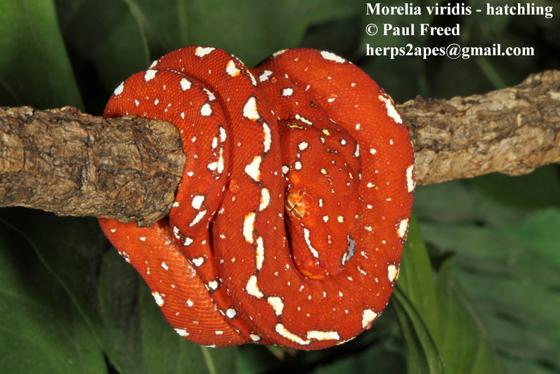
| Diagnosis | Diagnosis: Morelia viridis is easily distinguished from all subspecies of M. azurea by the following characters: presence of a single juvenile morph (yellow vs. yellow or red in M. azurea); presence of a tightly knitted row of white vertebral scales along the vertebral ridge, or white ‘rosettes’ along the vertebral ridge in the Aru Islands population; and a dark shade of green coloration along the vertebral ridge, as opposed to uniform green in M. azurea (Table 1, Supplementary Material II). Most populations of M. viridis also possess short, stubby tails and con- siderably lower subcaudal scale counts vs. long, tapering tails and high subcaudal scale counts in M. azurea (Table 1, Supplementary Material II). The exceptions are populations from Milne Bay and the north coast of Oro and Morobe Provinces to near Lae, Papua New Guinea, which typically have long, tapering tails similar to M. azurea. Morelia viridis further differs from M. a. azurea and M. a. utaraensis in that juveniles possess a single iris band running horizontally through the eye (as opposed to a triple iris band; Table 1; Supplementary Material II). It further differs from M. a. utaraensis in that juveniles have a darkened tail tip and a broken pattern following the vertebral ridge vs. a light- colored tail and continuous pattern. Morelia viridis further differs from M. a. azurea by undergoing a relatively rapid color change to become uniform green in adulthood vs. delayed colour change with variable coloration). [from Natusch et al. 2019] Unfortunately we had to temporarily remove additional information as this was scraped by multiple AI companies who sell that data to their customers. These details, e.g. detailed descriptions or comparisons (about 58 characters) are available for collaborators and contributors. Please contact us for details. |
| Comment | Hybridization: KIVIT & WISEMAN (2005) report a hybrid between M. viridis and M. spilota cheynei. See Switak (2006) for a collection of photos of color variants. Subspecies: Hoser (2003) diagnoses Chondropython viridis shireenae ssp. nov. as “the only Green Pythons (C. viridis) found on mainland Australia and can be separated from all other C. viridis on this basis. In the absence of good locality data, the subspecies is best separated from other C. viridis by comparative DNA analysis [missing in Hoser’s paper], which has already been successfully used to separate this subspecies. Australian C. viridis have as adults, white or other markings along the vertebra and few other markings, whereas those from elsewhere do not always have this trait. Hence this is a diagnostic character for Australian specimens of C. viridis.” Based on Hoser’s 2003 paper, the status of this subspecies remains uncertain. M. azureus was resurrected from the synonymy of M. viridis by Hoser (2009). Rawlings and Donnellan (2003) also revealed the existence of two populations that are genetically distinct, one from north of the central cordillera (corresponding to azurea), the other from the south, including the Aru Island and Australian populations. See also Esquerré et al. 2020 for a recent phylogenetic analysis. Habitat: arboreal, although categories as “not arboreal” by Harrington et al. 2018. |
| Etymology | Presumably named after the Latin viridis (green) in reference to the bright green coloration. (G. Shea, pers. comm., 9 Feb 2024) |
| References |
|
| External links |
|