You are here » home advanced search Silvascincus murrayi

Silvascincus murrayi (BOULENGER, 1887)
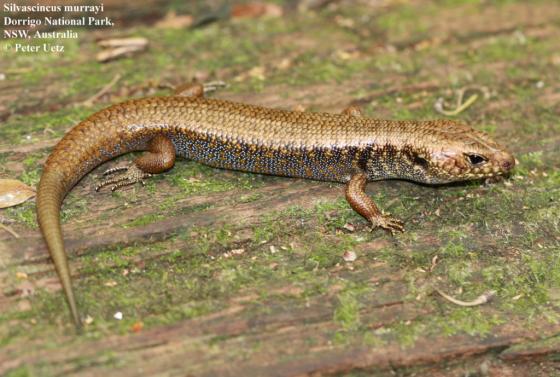
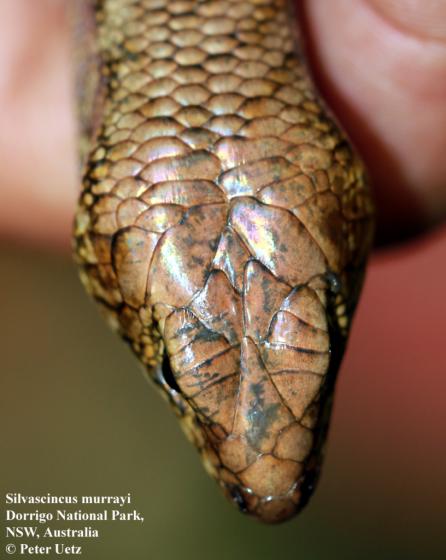
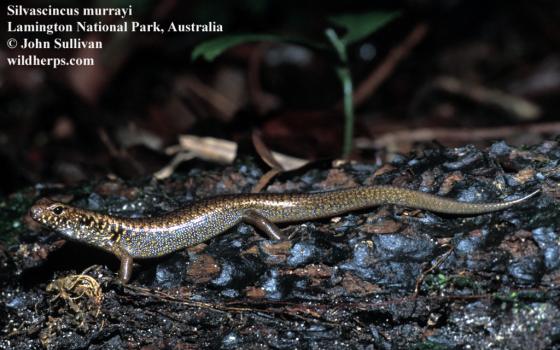
IUCN Red List - Silvascincus murrayi - Least Concern, LC

Can you confirm these amateur observations of Silvascincus murrayi?

Add your own observation of
Silvascincus murrayi »

We have no photos, try to find some by Google images search: Google images

Higher TaxaScincidae, Sphenomorphinae (Sphenomorphini), Scincoidea, Sauria, Squamata (lizards)
Subspecies 
Common NamesE: Blue-speckled Forest-skink 
SynonymLygosoma murrayi BOULENGER 1887: 232
Lygosoma tamburinense LÖNNBERG & ANDERSSON 1915: 5
Lygosoma (Hinulia) tenuis intermedius KINGHORN 1932
Sphenomorphus murrayi — COGGER 1983: 185
Concinnia murrayi — WELLS & WELLINGTON 1983
Eulamprus murrayi — COGGER 2000: 486
Karma murrayi — WELLS 2009
Eulamprus murrayi — WILSON & SWAN 2010
Eulamprus murrayi — WILSON & SWAN 2013
Silvascincus murrayi — SKINNER et al. 2013
Concinnia murrayi — COGGER 2014: 454
Karma murrayi — COGGER 2014: 978 (addendum)
Karma murrayi — SWAN et al 2017
Karma murrayi — SHEA 2019 
DistributionAustralia (New South Wales, Queensland)

Type locality: Qld.  
Reproductionovoviviparous 
TypesHolotype: BMNH 1946.8.21.32
Holotype: NFIRM 3212, from Mt. Tambourine, Qld. [Lygosoma tamburinense]
Holotype: QM J3023, from Macpherson Ranges, 3000 ft, S Qld. [tryoni]
Holotype: AM R6485, from Richmond River, N. S. W. [L. tenuis intermedius] 
DiagnosisDiagnosis (genus): Australian Sphenomorphus group scincids displaying the following combination of derived character states: third pairof enlarged chin scales separated by 5 (instead of 3) scale rows, visceral fat bodies absent, postmental contacts a single infralabial,pale to bright yellow ventral colouration (see Greer, 1989; Sadlier,1998).


Unfortunately we had to temporarily remove additional information as this was scraped by multiple AI companies who sell that data to their customers. These details, e.g. detailed descriptions or comparisons (about 1251 characters) are available for collaborators and contributors. Please contact us for details. 
CommentSynonymy partly after COGGER 1983. Lygosoma (Hinulia) tryoni LONGMAN 1918 hs been removed from the synonym of E. murrayi and reinstated to species status.

Type species: Lygosoma murrayi Boulenger, 1987 is the type species of the genus Silvascincus SKINNER et al. 2013.

Phylogenetics: see Singhal et al. 2017 and 2018 for a phylogeny of Australian sphenomorphine skinks.

Limb morphology: 5 digits, 5 toes (Singhal et al. 2018, Brandley et al 2008)

Morphology: Hutchinson et al. 2021 present a table of morphological character states across 20 Australian sphenomorphine skinks, including this genus.

Reference images: see Uetz et al. 2024 for high-resolution reference images for this species. 
EtymologyNamed after Sir John Murray (1841-1914), a Canadian marine naturalist and oceanographer.

The genus was named after the Latin silva, forest, and neo-Latin Scincus, a skink. The name refers to the forest habitat occupied bythese skinks.  
References
  • Beolens, Bo; Michael Watkins, and Michael Grayson 2011. The Eponym Dictionary of Reptiles. Johns Hopkins University Press, Baltimore, USA - get paper here
  • Boulenger, G. A. 1887. Catalogue of the lizards in the British Museum (Nat. Hist.) III. Lacertidae, Gerrhosauridae, Scincidae, Anelytropsidae, Dibamidae, Chamaeleontidae. London: 575 pp. - get paper here
  • Cogger, H. G. 2014. Reptiles and Amphibians of Australia, 7th ed. CSIRO Publishing, xxx + 1033 pp. - get paper here
  • Cogger, H.G. 2000. Reptiles and Amphibians of Australia, 6th ed. Ralph Curtis Publishing, Sanibel Island, 808 pp.
  • Couper, P., Covacevich, J., Amey, A. & Baker, A. 2006. The genera of skinks (Family Scincidae) of Australia and its island territories: diversity, distribution and identification. in: Merrick, J.R., Archer, M., Hickey, G.M. & Lee, M.S.Y. (eds.). Evolution and Zoogeography of Australasian Vertebrates. Australian Scientific Publishing, Sydney, pp. 367-384
  • Hutchinson, M. N., Couper, P., Amey, A., & Worthington-Wilmer, J. 2021. Diversity and Systematics of Limbless Skinks (Anomalopus) from Eastern Australia and the Skeletal Changes that Accompany the Substrate Swimming Body Form. Journal of Herpetology 55 (4): 361-384 - get paper here
  • Kinghorn, J. R. 1932. Herpetological notes 4. Rec. Austral. Mus. 18: 335-363 - get paper here
  • Lönnberg, E. & Andersson, G. L. 1915. Results of Dr. E. Mjöberg's Swedish Scientific Expeditions to Australia 1910-1913. VII. Reptiles collected in northern Queensland. Kungl. Svenska Vetensk. -Akad. Hand]. 52 (7): 1-9 - get paper here
  • Reeder, T.W. 2003. A phylogeny of the Australian Sphenomorphus group (Scincidae: Squamata) and the phylogenetic placement of the crocodile skinks (Tribolonotus): Bayesian approaches to assessing congruence and obtaining confidence in maximum likelihood inferred relationships. Molecular Phylogenetics and Evolution 27: 384–397 - get paper here
  • Shea, G.M. 2019. Current status of the genera Karma and Magmellia Wells, 2009 (Scincidae: Lygosominae: Sphenomorphini) with a morphological character to distinguish the two genera. Memoirs of the Queensland Museum – Nature 61: 187–191 - get paper here
  • Singhal, Sonal; Huateng Huang, Maggie R. Grundler, María R. Marchán-Rivadeneira, Iris Holmes, Pascal O. Title, Stephen C. Donnellan, and Daniel L. Rabosky 2018. Does Population Structure Predict the Rate of Speciation? A Comparative Test across Australia’s Most Diverse Vertebrate Radiation. The American Naturalist 192 (4): 432-447 - get paper here
  • Skinner, Adam; Mark N. Hutchinson, Michael S.Y. Lee 2013. Phylogeny and Divergence Times of Australian Sphenomorphus Group Skinks (Scincidae, Squamata). Molecular Phylogenetics and Evolution 69 (3): 906–918 - get paper here
  • Swan, G.; Sadlier, R.; Shea, G. 2017. A field guide to reptiles of New South Wales. Reed New Holland, 328 pp.
  • Uetz, P.H.; Patel, M.; Gbadamosi, Z.; Nguyen, A.; Shoope, S. 2024. A Reference Database of Reptile Images. Taxonomy 4: 723–732 - get paper here
  • Wells, R.W. 2009. Some taxonomic and nomenclatural considerations on the class Reptilia in Australia. A review of the genera Eulamprus and Glaphyromorphus (Scincidae), including the description of new genera and species. Australian Biodiversity Record (3): 1–96.
  • Wilson, S. & Swan, G. 2010. A complete guide to reptiles of Australia, 3rd ed. Chatswood: New Holland, 558 pp.
 
External links  
Is it interesting? Share with others:


Please submit feedback about this entry to the curator