
Sitana fusca SCHLEICH & KÄSTLE, 1998
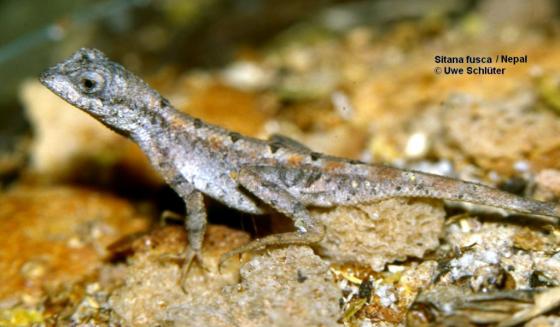
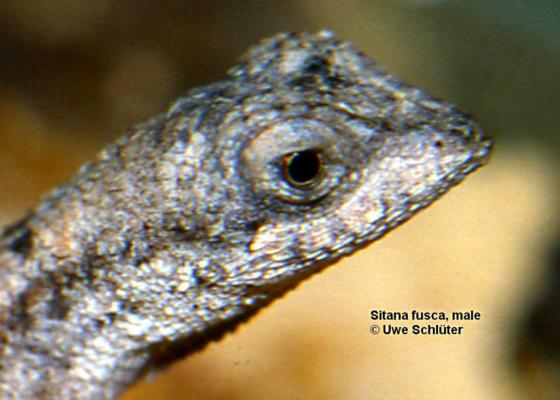

Can you confirm these amateur observations of Sitana fusca?
Sitana fusca
Find more photos by Google images search: 
| Higher Taxa | Agamidae (Draconinae), Sauria, Iguania, Squamata (lizards) |
| Subspecies | |
| Common Names | E: Dark Sitana |
| Synonym | Sitana fusca SCHLEICH & KÄSTLE 1998 Sitana fusca — KÄSTLE et al. 2013: 431 |
| Distribution | E Nepal Type locality: "East Nepal, Ghauri Dhara Road Camp 0.8 km north of the road Janatir-Bardibas. Geographic coordinates: 26º59'25.0" N, 85º53'45.6" E. |
| Reproduction | oviparous |
| Types | Holotype: ZSM 853/2012 (originally SHHS 1996/83, Fuhlrott-Museum Wuppertal): Paratypes: VW/D-96/21 and VW/D-96/22 (four paratypes), not in ZSM, whereabout unknown |
| Diagnosis | Diagnosis (n=12+): A small Sitana species which is closely related with Sitana sivalensis (fig. 2). In the field it differs by its much darker colour in life. Preserved females are difficult to distinguish from S. sivalensis, but males have a very pointed and depressed snout. jutting over the mental region (fig. 3). In Sitana sivalensis the mental plate is surrounded by four or five scutes (two infralabials and two or three postmentals), in S. fusca apparently always by five. In this species the first infralabials are rather long, and the connection lines of their posterior borders (dotted in fig. 4) divides the lateral postmentals approximately into halves, while in S. sivalensis this line transsects their anterior part. In sivalensis males the outline of the head is more oval (fig. 5) while the snout appears triangular in fusca. The last fan scales are - in contrast to S. sivalensis - very similar to the ventrals (fig. 6). In the reproductive phase S. fusca males lack the blue colour on the eyelids and the nuchal crest. Their venter never becomes pure white. The scales of the dorsal field are partially irregular in shape and size (fig. 7) and, in contrast to S. sivalensis, the longitudinal keel rows are frequently disturbed. The behaviour of S. fusca is characterised by the tolerance between males and a reduced challenge behaviour.” (Schleich & Kästle 1998) |
| Comment | Abundance: only known from its original description (Meiri et al. 2017). |
| Etymology | Named after Latin fusca = brown, dark, or dusky, although many specimens appear to be relatively lightly colored.. |
| References |
|
| External links |