
Alopoglossus grandisquamatus (RUEDA, 1985)

Can you confirm these amateur observations of Alopoglossus grandisquamatus?
Alopoglossus grandisquamatus
Find more photos by Google images search: 
| Higher Taxa | Alopoglossidae, Sauria, Gymnophthalmoidea, Squamata (lizards) |
| Subspecies | |
| Common Names | E: Common Largescale Lizard |
| Synonym | Ptychoglossus grandisquamatus RUEDA 1985 Ptychoglossus grandisquamatus — HARRIS 1994: 246 Ptychoglossus grandisquamatus — PÁEZ et al. 2002 Alopoglossus grandisquamatus — HERNÁNDEZ-MORALES et al. 2020 Ptychoglossus grandisquamatus — LINDKEN et al. 2024 |
| Distribution | NW Colombia Type locality: INGEOMINAS camp, Rio Amparradó, Municipality of Dabeiba, Antioquia, Colombia. |
| Reproduction | oviparous |
| Types | Holotype: ICN-MHN = ICN 5937, adult male |
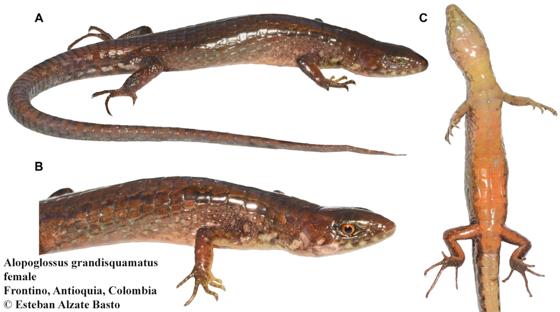
| Diagnosis | Diagnosis: Similar to P. eurylepis, the dorsal scales of this species are very wide, unkeeled and glossy instead of narrow and keeled as in the majority of Ptychoglossus species. It differs from P. eurylepis in the following respects: small, widely separated prefrontal scales present; five scales in first postparietal scale row; seven supralabials; six infralabials; narrow black dorsolateral stripes and a faint dark vertebral stripe. It also possesses three characters unique to the genus: a low number of transverse dorsal scale rows (26), a single triangular pre-gular scale instead of at least one complete row of pregulars crossing throat, and three broad strap-like gular scales resembling the ventral seutes of snakes. (Harris 1994) Unfortunately we had to temporarily remove additional information as this was scraped by multiple AI companies who sell that data. However, these details, e.g. detailed descriptions (about about 1.12 pages) are available for collaborators and contributors. Please contact us if you need any of this material. |
| Comment | Abundance: only known from the type specimen (Meiri et al. 2017). |
| Etymology | Named after the large dorsal body scales (Latin “squama” = scale). Compare to P. eurylepis, which means the same thing in Greek. |
| References |
|
| External links |