
Bronchocela moluccana (LESSON, 1830)
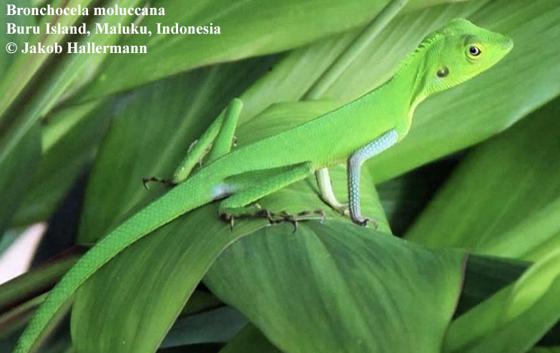

Can you confirm these amateur observations of Bronchocela moluccana?
Bronchocela moluccana
Find more photos by Google images search: 
| Higher Taxa | Agamidae (Draconinae), Sauria, Iguania, Squamata (lizards) |
| Subspecies | |
| Common Names | E: Maluku crested lizard G: Molukken-Langschwanzagame, Molukken-Schönechse |
| Synonym | Agama moluccana LESSON 1830: 34 (1829 fide LESCURE 2015) Bronchocela moluccana — PETERS 1867: 17 Calotes cristatellus moluccanus — KOPSTEIN 1927: 439 Calotes cristatellus moluccanus — BRONGERSMA 1948: 489 Calotes cristatellus moluccanus — TANNER 1950 Bronchocela moluccana — AMARASINGHE et al. 2026: 101 |
| Distribution | Indonesia (Central Maluku: Buru Island, Ambon Island, and Seram Island) Type locality: “Cajéli,” Buru Island, Indonesia. Neotype locality: Kayeli (= Cajéli), Buru Island, Maluku, Indonesia. |
| Reproduction | oviparous |
| Types | Neotype: NHMUK 1910.4.26.21, adult male, collected by G. William Stalker, and entered into the museum registry on 26th April 1910 (designated by Amarasinghe et al. 2026). Holotype: MNHN (lost). An adult specimen of 81 mm SVL (probably a female due to rudimentary nuchal scales in figure 1 on Plate 1 of Lesson 1830), presented to the Paris Museum in 1828, and lost ever since (Brygoo 1988). |
| Diagnosis | Diagnosis: A species of Bronchocela, morphologically somewhat close to its allopatric congeners: B. jubata on Java, B. celebensis on Sulawesi, and B. hayeki in Sumatra in body posture and colouration, but differs from all species by having medium-sized body (67.2– 101.5 mm SVL; 88.9 ± 9.1, n = 19) in adults; relative tail length (267.8–394.9% of SVL; 321.5 ± 31.2, n = 19); a large gular pouch in males; midgular scales enlarged; 8–10 enlarged ventral scale rows; ventrals 3–5 times larger than dorsals; 66–82 ventrals (73.8 ± 4.7, n = 19); lateral body scales narrowly acute, feebly keeled; 4 or 5 upper dorsal scale rows on the lateral body directed upward along the body; nuchal crest developed, crescent in shape; 10–14 nuchal crest scales to the level of axilla; longest nuchal crest scale shorter than eye diameter; dorsal crest distinct, continue with a 4–6 vertebral scales gap after nuchal crest; scales on temporal region not enlarged; 7 or 8 temporal scale rows between orbit and tympanum; 5–7 canthal scales between supranasal and anterior border of orbit; canthal edge sharp; 50–68 scale rows at midbody (58.6 ± 5.1, n = 19); 3rd finger shorter than 4th finger; 80– 94 paravertebrals (86.3 ± 4.2, n = 19), first paravertebral row enlarged. (Amarasinghe et al. 2026) Unfortunately we had to temporarily remove additional information as this was scraped by multiple AI companies who sell that data. However, these details, e.g. detailed descriptions (about less than half a page) are available for collaborators and contributors. Please contact us if you need any of this material. |
| Comment | Distribution: see map in Amarasinghe et al. 2026: 103 (Fig. 5) |
| Etymology | Named after the type locality in the Molucca islands. |
| References |
|
| External links |