
Ctenotus inornatus (GRAY, 1845)


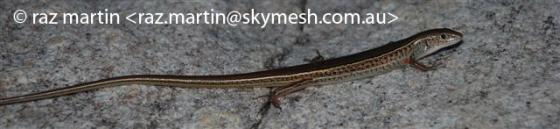
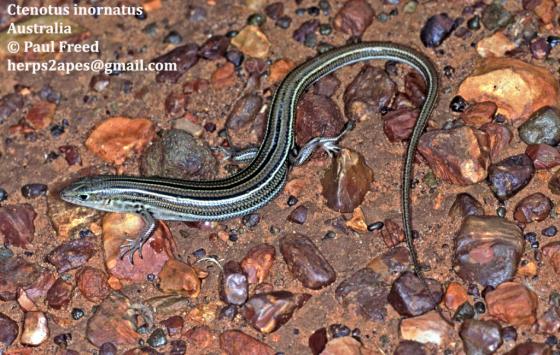

Can you confirm these amateur observations of Ctenotus inornatus?
Ctenotus inornatus
Find more photos by Google images search: 
| Higher Taxa | Scincidae, Sphenomorphinae (Sphenomorphini), Scincoidea, Sauria, Squamata (lizards) |
| Subspecies | |
| Common Names | E: Bar-shouldered Ctenotus E: Stony-soil Ctenotus [saxatilis] |
| Synonym | Hinulia inornata GRAY 1845: 78 Ctenotus saxatilis STORR 1970: 101 Ctenotus inornatus — STORR 1975: 221 Ctenotus inornatus — COGGER 1983: 148 Ctenotus saxatilis — COGGER 1983: 152 Minervascincus saxatilis — WELLS & WELLINGTON 1985: 35 Minervascincus inornatus — WELLS & WELLINGTON 1985: 35 Ctenotus inornatus — COGGER 2000: 429 Ctenotus saxatilis — COGGER 2000: 441 Ctenotus saxatilis — COUPER et al. 2006 Ctenotus saxatilis — WILSON & SWAN 2010 Ctenotus inornatus — WILSON & SWAN 2010 Ctenotus inornatus — PRATES et al. 2023 Ctenotus “saxatilis” — PRATES et al. 2023 |
| Distribution | Australia (Northern Territory,Queensland,Western Australia) Type locality: Swan River, W. A. (in error) fide Storr (1970) saxatilis: Australia (Northern Territory, South Australia, Western Australia). Type locality: 10 mi E of Tennant Creek, in 19° 40’ S, 134° 20’ E, N. T. |
| Reproduction | oviparous |
| Types | Holotype: BMNH 1946.8.15.45 Holotype: WAM R24239 [saxatilis] Holotype: WAM R25680 [severus] Holotype: WAM R30004 [helenae] Holotype: WAM R33780 [fallens] Holotype: NMV D13944 [brachyonyx] |
| Diagnosis | Diagnosis: in Rabosky et al. 2014. Unfortunately we had to temporarily remove additional information as this was scraped by multiple AI companies who sell that data. However, these details, e.g. detailed descriptions (about about .74 pages) are available for collaborators and contributors. Please contact us if you need any of this material. |
| Comment | Synonymy: Rabosky et al. (2014) found no genetic pattern that differentiated inornatus from helenae, saxatilis, serverus, fallens, or brachyonyx and thus synonymized them with inornatus. Similarly, Prates et al. (2023) presented a more detailed genetic analysis within the complex but refrained from taxonomic recommendations, given the frequent paraphylies and thus unresolved taxonomic issues. Habitat: Triodia sandplains and flat rocky areas (Shea et al., 1988). Behavior: The species is active during the day and terrestrial (Shea et al. 1988). NCBI tax IDs: saxatilis = 480777 (Reptile Database ID = 12842), severus = 480783 (12848), helenae = 480746 (12802), fallens = 480739 (12794), brachyonyx = no NCBI (12778). Note that NCBI tax IDs are not preserved once species get synonymized. If any of them get revalidated they will get new NCBI IDs. Limb morphology: 5 digits, 5 toes (Singhal et al. 2018, Cogger 2014) Distribution: see map in Prates et al. 2023: 5 (Fig. 2) |
| Etymology | Presumably named after the Latin inornatus (unadorned) in reference to the relatively plain coloration. (G. Shea, pers. comm., 9 Feb 2024) C. saxatilis was named after the Latin saxatilis (among rocks), relating to the habitat preference. (G. Shea, pers. comm., 9 Feb 2024) |
| References |
|
| External links |
|