
Liolaemus ornatus KOSLOWSKY, 1898

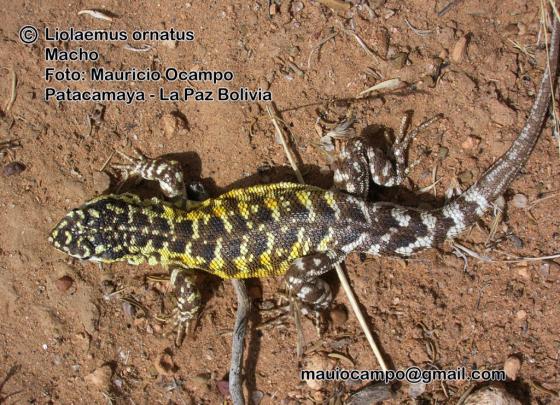
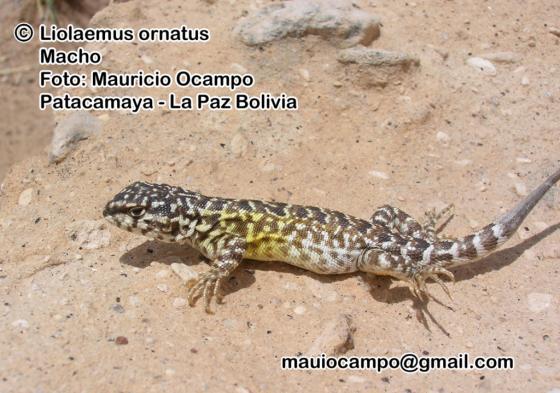

Can you confirm these amateur observations of Liolaemus ornatus?
Liolaemus ornatus
Find more photos by Google images search: 
| Higher Taxa | Liolaemidae, Iguania, Sauria, Squamata (lizards) |
| Subspecies | |
| Common Names | E: Ornate Tree Iguana S: Lagartija ornamentada |
| Synonym | Liolaemus ornatus KOSLOWSKY 1898: 178 Liolaemus simonsi BOULENGER 1902: 398 (fide LAURENT 1992) Liolaemus mocquardi PELLEGRIN 1909: 325 (fide LAURENT 1992) Liolaemus pulcher PELLEGRIN 1909 (fide LAURENT 1992) Liolaemus pulcher — RENDAHL 1937 Liolaemus mocquardi — PEARSON & BRADFORD 1976 Liolaemus ornatus —PETERS et al. 1970: 191 Liolaemus ornatus — CEI 1993 Liolaemus ornatus — DIRKSEN & DE LA RIVA 1999 Liolaemus (Eulaemus) ornatus — SCHULTE et al. 2000 Liolaemus (Eulaemus) ornatus — RAMIREZ LEYTON & PINCHEIRA-DONOSO 2005: 138 Liolaemus lopezi IBARRA-VIDAL 2005 Liolaemus ornatus — PINCHEIRA-DONOSO & NUNEZ 2005: 90 Liolaemus enigmaticus PINCHEIRA-DONOSO & NUNEZ 2005: 85 Liolaemus lopezi — TRONCOSO-PALACIOS et al. 2019 Liolaemus (Eulaemus) ornatus — MORANDO et al. 2020 Liolaemus ornatus — RUIZ et al. 2021 |
| Distribution | Chile, Argentina (Jujuy, Catamarca, Salta), Bolivia (La Paz, Oruro, Potosí, Tarija), Peru (Altiplano) Type locality: Cordilleras de la provincia de Jujuy, Argentina (KOSLOWSKY 1898). Neotype locality: 3 km NW of Abra Pampa (22°43'S, 65°42'W) on Ruta Prov. 7, 3460 meters, Departamento de Cochinoca, Provincia de Jujuy, Republica de Argentina. lopezi (invalid): Chile; Type locality: “Quebrada de Chulluncani, 3 kms al sur de Villa Blanca, Colchane, altiplano I Región". |
| Reproduction | Viviparous |
| Types | Neotype: MLP S.1162, designated by Etheridge 1993: 171. The syntypes are lost fide Etheridge 1993: 171. Syntype: NMW 18911 [pulcher] Holotype: MRC 1099 (given as Coll. Herp. Mus. Hist. Nat. Concepción) [lopezi] |
| Diagnosis | Diagnosis: Adult males of Liolaemus ornatus differ from other members of the L. dalwinii complex in having the dorsal ground color of the head and neck darker than the rest of the body, and from L. datwinii, L. olongasta and L. laurenti in lacking intensely black pigment in the antehumeral fold, from L. dalwinii, L. koslowskyi and L. abaucan in lacking conspicuously enlarged prescapular and postscapular spots, from L. abaucan and L. uspal/atensis in having larger, more distinctly keeled, scales, from L. irregularis in having a distinct, more-or-less symmetrical pattern, and from L. quilmes and all other species save L. irregularis, in having precloacal pores in more than 95 per cent, rather than fewer than 10 per cent, of females (Etheridge 1993: 172). Unfortunately we had to temporarily remove additional information as this was scraped by multiple AI companies who sell that data. However, these details, e.g. detailed descriptions (about about 4.13 pages) are available for collaborators and contributors. Please contact us if you need any of this material. |
| Comment | Member of the darwinii group of Liolaemus. L. lopezi is only known from the type specimen (Pincheira-Donoso, pers. comm, 3 Apr 2017). Demangel 2016 synonymized this species with L. ornatus, a decision that was not supported by TRONCOSO-PALACIOS et al. 2019 (but without the latter providing evidence for its validity either). Abundance: only known from the type specimen (Meiri et al. 2017). RDB speciesID: 15672 [lopezi] Etymology (lopezi): Named after Dr. Luis López Cabrera, from Iquique, who helped to carry out the expedition that led to the discovery of this species. |
| Etymology | Presumed to refer to the brightly colored, ornate pattern characteristic of adult males of the species (Etheridge 1993: 172). |
| References |
|
| External links |