
Phyllopezus sapiranga DUBEUX, DUBEUX, NEVES, WERNECK, RODRIGUES, MOTT & NUNES, 2025
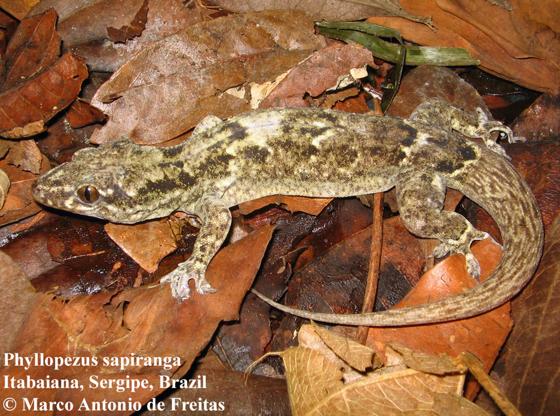

Can you confirm these amateur observations of Phyllopezus sapiranga?
Phyllopezus sapiranga
Find more photos by Google images search: 
| Higher Taxa | Phyllodactylidae, Gekkota, Sauria, Squamata (lizards: geckos) |
| Subspecies | |
| Common Names | |
| Synonym | Phyllopezus sapiranga DUBEUX, DUBEUX, NEVES, WERNECK, RODRIGUES, MOTT & NUNES 2025: 179 |
| Distribution | Brazil (Bahia) Type locality: Serra da Jiboia (− 12.87155, − 39.48088; 496 m a.s.l.), municipality of Elísio Medrado, Bahia state, Brazil. |
| Reproduction | |
| Types | Holotype. CHUFPE-R 1962 (adult male), collected on 20 July 2023 by MJMD, PMSN, Lucas Silva Rodrigues and Thiago Nascimento, field number PMSN 1370. Paratypes. Adult females (CHUFPE-R 1963, 1966, 1968, 1969, 1970, 1971) and adult males (CHUFPE-R 1960, 1961, 1964, 1965, 1967), juvenile undetermined sex (CHUFPE-R 1972), same collection information as the holotype. Adult male (MZUSP 100045), collected on 25 March 2010 by Marco de Freitas from the same locality of holotype (topotypes); adult female (CHUFPB 20625) and adult males (CHUFPB 20626, CHUFPB 20627, CHUFPB 20630), collected on 16 November 2013 by Adrian Garda from the same locality of holotype (topotypes); adult male (UFRNCH 4579) collected on 22 Jul 2012 by Eliza Freire, from municipality of Varzedo, Bahia state, Brazil (− 12.925926, − 39.443742; 305 m a.s.l.). |
| Diagnosis | Diagnosis: P. sapiranga sp. nov. is characterized by the following combination of characters: (1) increased scales separating the postmental granules in the gular region; (2) posterior margin of the mental scale not exceeding the anterior margin of the second infralabial scale; (3) postmental scales in direct contact; (4) mental scale slightly wider than long, bell-shaped; (5) posterior margin of the postmental scales exceeding half of the second infralabial, (6) one to two scales in contact with the first infralabial; (7) central pair of postmentals distinctly larger than the scales that surround them and in contact with the first infralabial; (8) six or seven infralabial scales; (9) postmental scales twice longer than wide; (10) larger dorsal tubercles, corresponding to about six granules forming rows; (11) developed pollex; (12) seven to eight supralabial scales; (13) cycloid scales around the auditory meatus, little bristly; (14) central scale of the row surrounding the postmentals large, about twice as large as the others; (15) mental bell-shaped; (16) greater number of ventrals in a longitudinal row (VLR 50–55); (17) posterior arrangement of sensory organs in granules and tubercles, not reaching the dorsal margin of the scales and presenting equidimensional tubercles; (18) tubercles smooth; (19) highest level of the tubercles in their caudal portion; and (20) large size (56.34–108.44 mm). See 3.6 section for additional comparisons. (Dubeux et al. 2025) Unfortunately we had to temporarily remove additional information as this was scraped by multiple AI companies who sell that data. However, these details, e.g. detailed descriptions (about less than half a page) are available for collaborators and contributors. Please contact us if you need any of this material. |
| Comment | Distribution: for a map of localities see Dubeux et al. 2025: 174 (Fig. 1, as Phyllopezus sp.). |
| Etymology | Named after Marco Antônio de Freitas (also known as Marco "Sapiranga"), a herpetologist whose tireless efforts in research, management and fiscalization of several protected areas in the state of Bahia, has helped and helps contribute to the knowledge and conservation of Brazilian herpetofauna. |
| References |
|
| External links |