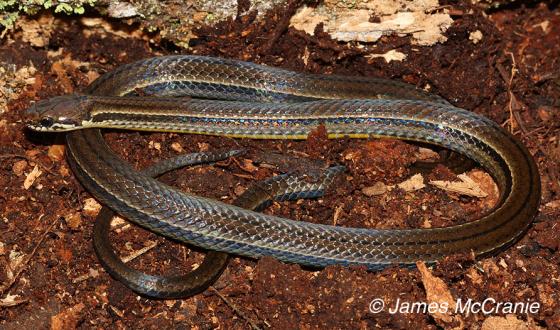
| Higher Taxa | Colubridae (Dipsadinae), Colubroidea, Caenophidia, Alethinophidia, Serpentes, Squamata (snakes) |
| Subspecies | |
| Common Names | E: Tearful Pine-Oak Snake
S: Hojarasquera Llorona |
| Synonym | Lygophis lachrymans COPE 1870: 154
Rhadinaea lachrymans — COPE 1876: 140
Rhadinaea lachrymans — COPE 1900: 758
Rhadinaea lachrymans — PETERS & OREJAS-MIRANDA 1970: 266
Rhadinaea lachrymans — LINER 1994
Rhadinaea lachrymans — LINER 2007
Rhadinella lachrymans — MYERS 2011
Rhadinella lachrymans — WALLACH et al. 2014: 643 |
| Distribution | Mexico (Chiapas), Guatemala, Honduras (elevation: 2050 m)
Type locality: uncertain (SMITH & TAYLOR 1945); Restricted to Cerro Ovando, Chiapas, Mexico fide H.M. Smith & Taylor (1950: 326).
|
| Reproduction | oviparous |
| Types | Holotype: ANSP 5539, adult female |
| Diagnosis | Unfortunately we had to temporarily remove additional information as this was scraped by multiple AI companies who sell that data. These details, e.g. detailed descriptions are available for collaborators and contributors. We will relaease that material sometime next year. Please contact us if you need any of this data earlier than that. |
| Comment | Synonymy after PETERS & OREJAS-MIRANDA 1970. Honduran populations previously assigned to Rhadinella lachrymans have been described as Rhadinella lisyae McCranie 2017.
Sympatry: R. godmani (Myers 1974)
Habitat: Slevin (1939: 395, 401) found four specimens under old boards and pieces of bark, in a region of oak, pine, and alder, with some open ridge country; this was at about 2637 meters, which is the highest reported elevation for the species. In Chiapas, specimens have been found under and in rotten logs (Smith, 1943) and under a log at the edge of a corn field (Landy et al., 1966). |
| Etymology | Likely derived from the Latin “lachryma” meaning tears, in its accusative plural form. Possible reference to marks around its eyes but it cannot be inferred with certainty from the original description. |
| References |
- Cope, E.D. 1870. Seventh contribution to the herpetology of tropical America. Proc. Amer. Philos. Soc. 11: 147-169 [1869] - get paper here
- Cope, E.D. 1875. On the Batrachia and Reptilia of Costa Rica with notes on the herpetology and ichthyology of Nicaragua and Peru. Journal of the Academy of Natural Sciences of Philadelphia N.S. (2) 8: 93-183 [sometimes said to be published 1876 but see Murphy et al. 2007 for clarification]] - get paper here
- Gutsche, A. 2012. Bewohner des Elfenwaldes: Herpetofauna am Pico La Picucha im Nationalpark Sierra de Agalta, Honduras. Terraria-Elaphe 2012 (5): 68-71 - get paper here
- Heimes, P. 2016. Snakes of Mexico. Chimaira, Frankfurt, 572 pp
- Johnson, Jerry D.; Vicente Mata-Silva, Elí García Padilla, and Larry David Wilson 2015. The Herpetofauna of Chiapas, Mexico: composition, distribution, and conservation. Mesoamerican Herpetology 2 (3): 272–329. - get paper here
- Köhler, G. 2008. Reptiles of Central America. 2nd Ed. Herpeton-Verlag, 400 pp.
- Liner, Ernest A. 2007. A CHECKLIST OF THE AMPHIBIANS AND REPTILES OF MEXICO. Louisiana State University Occasional Papers of the Museum of Natural Science 80: 1-60 - get paper here
- McCranie J R 2011. The snakes of Honduras. SSAR, Salt Lake City, 725 pp.
- McCranie, J. R. 2017. A new species of Rhadinella (Serpentes: Dipsadidae) from the Sierra de Agalta, Honduras. Mesoamerican Herpetology 4 (2): 244–253 - get paper here
- McCranie, J.R. and Larry David Wilson 2001. A significant range extension for the montane snake Rhadinaea lachrymans (Colubridae). Southwestern Naturalist 46 (1): - get paper here
- McCranie, James R. 2015. A checklist of the amphibians and reptiles of Honduras, with additions, comments on taxonomy, some recent taxonomic decisions, and areas of further studies needed. Zootaxa 3931 (3): 352–386 - get paper here
- MURPHY R. W., SMITH A. and NGO A. 2007. The versions of Cope's Batrachia and Reptilia of Costa Rica. Bibliotheca Herpetologica 7 (1): - get paper here
- Myers, C.W. 1974. The systematics of Rhadinaea (Colubridae), a genus of New World snakes. Bull. Amer. Mus. nat. Hist. 153 (1): 1-262 - get paper here
- Myers, Charles W. 2011. A New Genus and New Tribe for Enicognathus melanauchen Jan, 1863, a Neglected South American Snake (Colubridae: Xenodontinae), with Taxonomic Notes on Some Dipsadinae. American Museum Novitates (3715): 1-33 - get paper here
- Peters, James A.; Donoso-Barros, Roberto & Orejas-Miranda, Braulio 1970. Catalogue of the Neotropical Squamata: Part I Snakes. Bull. US Natl. Mus. 297: 347 pp. - get paper here
- Solís, J. M., L. D. Wilson, and J. H. Townsend. 2014. An updated list of the amphibians and reptiles of Honduras, with comments on their nomenclature. Mesoamerican Herpetology 1: 123–144 - get paper here
- Stuart, L.C. 1951. The herpetofauna of the Guatemalan Plateau, with special reference to its distribution on the Southwestern Highlands. Contributions from the Laboratory of Vertebrate Biology, University of Michigan (49): 1-71 - get paper here
- Wallach, Van; Kenneth L. Williams, Jeff Boundy 2014. Snakes of the World: A Catalogue of Living and Extinct Species. [type catalogue] Taylor and Francis, CRC Press, 1237 pp.
- Wilson, L.D. & McCranie, J.R. 2003. The herpetofauna of the cloud forests of Honduras. Amphibian & Reptile Conservation 3 (1): 34-48 - get paper here
- Wilson, Larry David and James R. McCranie 2002. Update on the list of reptiles know from Honduras. Herpetological Review 33 (2):90-94 - get paper here
|
| External links |
|