
Siderolamprus rozellae (SMITH, 1942)
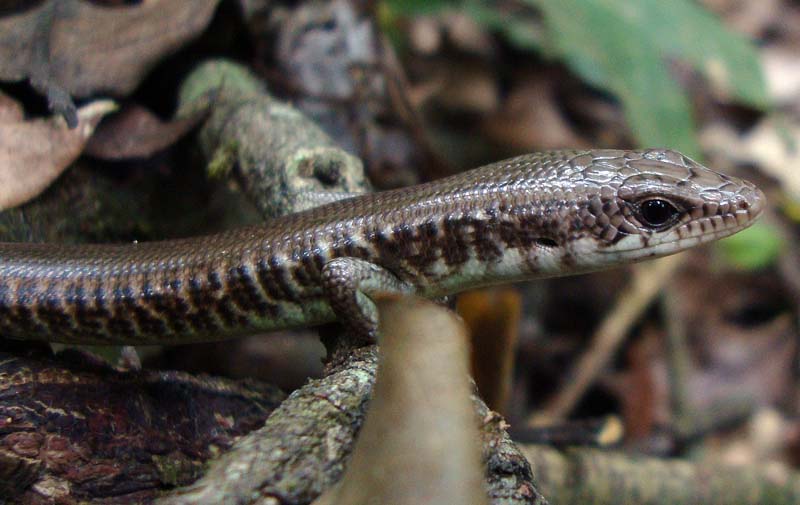


Can you confirm these amateur observations of Siderolamprus rozellae?
Siderolamprus rozellae
Find more photos by Google images search: 
| Higher Taxa | Diploglossidae, Diploglossa, Anguimorpha, Sauria, Squamata (lizards) |
| Subspecies | |
| Common Names | E: Rozella's Lesser Galliwasp S: Celesto Vientre Verde |
| Synonym | Celestus rozellae SMITH 1942: 372 Celestus rozellae — SMITH & TAYLOR 1950: 195 Celestus rozellae — STUART 1963 Celestus rozellae — LINER 1994 Diploglossus rozellae — CAMPBELL 1998 Celestus rozellae — KÖHLER 2000: 41 Diploglossus rozellae — WERLER & CAMPBELL 2004 Celestus rozellae — MATA-SILVA et al. 2015 Siderolamprus rozellae — SCHOOLS & HEDGES 2021 |
| Distribution | S Mexico (Veracruz, Oaxaca, Quintana Roo), Guatemala, Belize (up to 1350 m) Type locality: vicinity of Palenque, Chiapas. |
| Reproduction | ovoviviparous |
| Types | Holotype: USNM 113526 (collected by Rozella Smith) |
| Diagnosis | Diagnosis: Scale rows 31 to 33; frontal in contact with a single prefrontal; latter in contact with only anterior supraocular; 8 to 10 labials to posterior edge of supraocular; first labial not extending beyond anterior margin of naris; median loreal as long as either of the others, or longer; portion of rostral visible from above greater than its distance from second pair of internasals; sides dark with vertical light bars, in young and adults; young with a broad, dorsolateral light stripe on each side, fading and indistinguishable in adults. (Smith 1942) Unfortunately we had to temporarily remove additional information as this was scraped by multiple AI companies who sell that data. However, these details, e.g. detailed descriptions (about about 1.61 pages) are available for collaborators and contributors. Please contact us if you need any of this material. |
| Comment | Distribution: not in Yucatan state (Mexico) according to GONZÁLEZ-SÁNCHEZ et al. 2017. Has been reported for Honduras. Not listed for Honduras by KÖHLER (2000). Not listed for Honduras by WILSON & MCCRANIE (2002). |
| Etymology | A patronimic after Rozella B. Smith, wife of Hobart Smith, the species’ author, who discovered and caught the holotype. |
| References |
|
| External links |