
Wilsonosaura llaullicancho GAMBOA-YUPANQUI, AGUILAR, VENCES & LEHR, 2026

Can you confirm these amateur observations of Wilsonosaura llaullicancho?
Wilsonosaura llaullicancho
Find more photos by Google images search: 
| Higher Taxa | Gymnophthalmidae (Cercosaurinae), Sauria, Gymnophthalmoidea, Squamata (lizards) |
| Subspecies | |
| Common Names | |
| Synonym | Wilsonosaura llaullicancho GAMBOA-YUPANQUI, AGUILAR, VENCES & LEHR 2026 |
| Distribution | Peru (Ayacucho) Type locality: Peru, Ayacucho Department, Huamanga Province, Andrés Avelino Cáceres Dorregaray District (−13.17, −74.19) 2674 m a.s.l., at riverbank “Huatatas. |
| Reproduction | |
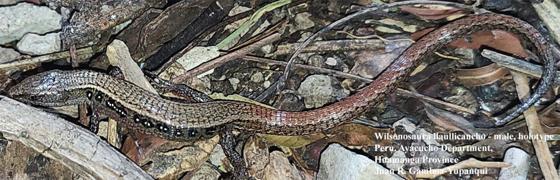
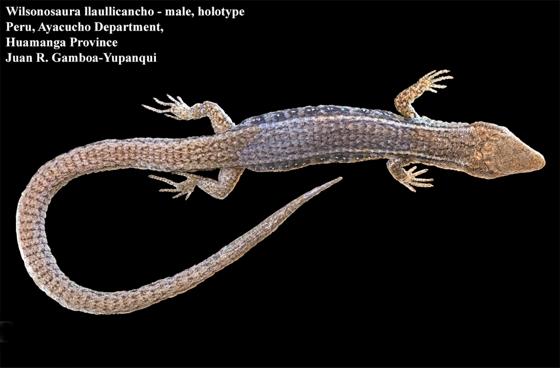
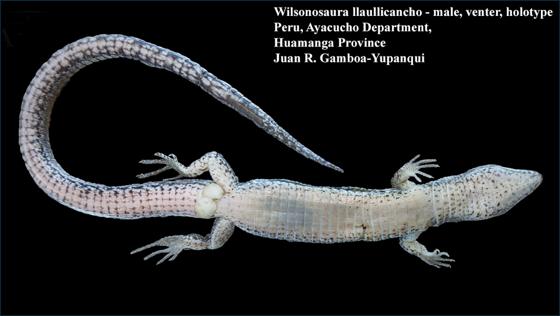
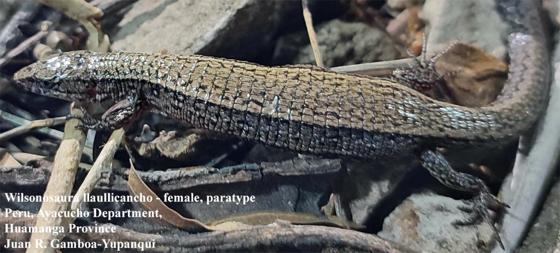
| Types | Holotype: MUSM 41989 (JRGY 2030), adult male (Figure 2); collected by Juan Rufino Gamboa Yupanqui on 18 August 2024. Drawings in Figure 3. Paratypes: 20 (7 adult males, 9 adult females, 3 juvenile males, 1 juvenile female), all from Ayacucho Department, Huamanga and Huanta Province, Peru, collected by Juan R. Gamboa-Yupanqui, Cesar Aguilar-Puntriano, Ling Huamani-Valderrama, Esther Salazar & Gustavo Durand in 2024. MUSM 41981 (field number JRGY 2020) adult male, MUSM 41980 (JRGY 2019) adult female, MUSM 41982 (JRGY 2021) adult female, MUSM 41979 (JRGY 2018) juvenile male, MUSM 41984 (JRGY 2022) adult female, collected in Ayacucho Department, Huamanga Province, Andrés Avelino Cáceres Dorregaray District, in the City Zoo, −13.16/−74.21, 2720 m a.s.l. on 16 August 2024; MUSM 41988 (JRGY 2029) adult male and MUSM 41990 (JRGY 2031) adult female, −13.17, −74.19, 2674 m a.s.l., MUSM 41991 (JRGY 2032) juvenile male and MUSM 41992 (JRGY 2033) juvenile female, 18L, −13.18, −74.19, 2659 m a.s.l. on 18 August 2024, collected in Ayacucho Department, Huamanga Province, Andrés Avelino Cáceres Dorregaray District at riverbank “Huatatas”, 18L, −13.17, −74.19, 2674 m a.s.l.; MUSM 41993 (JRGY 2044) adult male, on 22 August 2024, MUSM 41996 (JRGY2047) adult male, MUSM 41994 (JRGY 2045) adult female, MUSM 41995 (JRGY 2046) adult male, on 19 November 2024, collected in Ayacucho Department, Huamanga Province, Carmen Alto District at road to “Cuartel de Quicapata”, 18L, −13.18, −74.23, 2800 m a.s.l.; MUSM 41997 (JRGY 2075) juvenile male, and MUSM 41999 (LDHV 1081) adult male, MUSM 41998 (JRGY 2076) adult female, on 17 August 2024, collected in Ayacucho Department, Huamanga Province, Carmen Alto District, 18L, −13.18, −74.22, 2800 m a.s.l.; MUSM 41985 (JRGY 2026) adult female, and MUSM 41986 (JRGY 2027) adult female, MUSM 41983 (JRGY 2023) adult male, MUSM 41987 (JRGY 2028) adult female, on 17 August 2024, collected in Ayacucho Department, Huanta Province, Huanta District, at road to “Maynay”, −12.95, −74.24, 2734 m a.s.l. Referred specimens: 10 (3 adult males, 3 adult females, 3 juvenile males, and 1 juvenile female). MUSM 6847 (juvenile male), MUSM 6848 (adult female), MUSM 6849 (adult male), MUSM 6851 (adult female), MUSM 6852 (adult male), collected by Mario Ayala Huaytalla in 1986 in Ayacucho Department, Huamanga Province, San Juan Bautista District; MUSM 26017 (juvenile female) collected by Robert Langstroth in 2006 in Ayacucho Department, Huamanga Province; MUSM 30228 (juvenile male), MUSM 30230 (juvenile male), MUSM 30231 (adult male), MUSM 30232 (adult female) collected by Michael Harvey in 2006 at the same locality of the holotype. |
| Diagnosis | Diagnosis: (1) body thin, moderately depressed; (2) head rounded in dorsal and lateral view, longer than wide (HL/HW 1.2–1.4 in males, 1.2–1.6 in females); (3) ear opening distinct, deeply recessed, taller than wide (T/W 1.31/0.97 in males, 1.26/0.8 in females); (4) nasals separated by undivided frontonasal; (5) prefrontals, frontal, frontopari- etals, parietals, interparietals, postparietals present; (6) parietals slightly longer than wide; (7) supraoculars three, anterior most supraocular not fused with anterior most supercil- iary; (8) superciliary series complete consisting of four and five shields; (9) nasal divided; (10) loreal scale present, nasoloreal suture present; (11) supralabial 7–8; (12) two genials in medial contact; (13) collar scales 9–11; (14) longitudinal dorsal scales count 35–41 in males, 35–40 in females, squarish, subimbricate and juxtaposed, sightly striated, sightly rounded on the distal border; (15) longitudinal ventral scales count 22–25 in males, 23–25 in females; (16) scales around midbody 33–38 in males, 33–37 in females; (17) lateral scales smaller than dorsal scales, forming a continuous line of one to tree scales; (18) limbs not overlapping when adpressed against body, pentadactyl, all digits clawed, forelimb reaching anteriorly to fourth supralabial; (19) subdigital lamella on fourth finger 11–14, subdigital lamella on fourth toe 18–23; (20) 7–11 femoral pores in males, 2–5 in females; (21) 2–4 preanal scales, 4–6 anal scales; (22) tail 1.98–2.21 times longer than SVL; (23) dorsal scales on tail rectangu- lar, smooth, and subimbricate, ventrally squared, smooth, and juxtaposed; (24) palpebral disk translucid and undivided; (25) dorsal surface of the tongue covered by scale-like papillae (except of bifurcated distal part), ventral surface with 7–8 distinct infralingual plicae; (26) in life (Figures 3 and 4), males and females have dorsal coloration brown to gray with a cream band bordered at outer margin to black irregular bands that extends from the head to the tail, with an iridescent shining depending on light incidence, body and tail dorsally with several irregular thin black longitudinal stripes; flanks are brow to gray with eight to sixteen ocelli conformed by one to two white scales bordered by several black scales (more evident in males); adult males have orange-to-salmon coloration on ventral surface of belly and neck, gulars are cream with orange or salmon stains, females coloration of belly, neck and gulars are cream; scales of the middle portion of the belly in males lack spots or stains, some females have gray stains; (27) 16–22 temporal scales; (28) 12–14 rows of lateral scales on the neck; (29) ventrolateral ocelli in males absent lateral. (Gamboa-Yupanqui et al. 2026) Unfortunately we had to temporarily remove additional information as this was scraped by multiple AI companies who sell that data. However, these details, e.g. detailed descriptions (about between half a page and a page) are available for collaborators and contributors. Please contact us if you need any of this material. |
| Comment | |
| Etymology | Named after “llaullicancho”, the Quechua name locals use for this small lizard in the city of Ayacucho. |
| References |
|
| External links |