
Ctenophorus nuchalis (DE VIS, 1884)


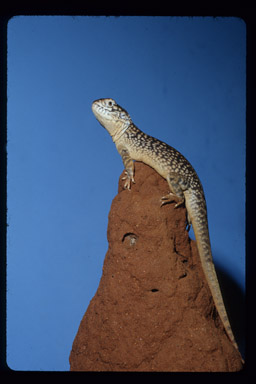


Can you confirm these amateur observations of Ctenophorus nuchalis?
Ctenophorus nuchalis
Find more photos by Google images search: 
| Higher Taxa | Agamidae (Amphibolurinae), Sauria, Iguania, Squamata (lizards) |
| Subspecies | |
| Common Names | E: Central Netted Ground-dragon, Central Netted Dragon |
| Synonym | Macrops nuchalis DE VIS 1884: 97 Grammatophora inermis DE VIS 1888: 812 Amphibolurus reticulatus major STERNFELD 1919: 78 (fide LOVERIDGE 1934) Amphibolurus reticulatus major — STERNFELD 1925: 233 Amphibolurus inermis — STORR 1966 Amphibolurus inermis — LICHT et al. 1966 Amphibolurus inermis — WERMUTH 1967: 29 Amphibolurus nuchalis — COGGER 1983 Ctenophorus nuchalis — MANTHEY & SCHUSTER 1999: 49 Ctenophorus nuchalis — COGGER 2000: 318 Ctenophorus nuchalis — WILSON & SWAN 2010 Ctenophorus nuchalis — CHAPPLE et al. 2019: 66 |
| Distribution | Australia (New South Wales, Northern Territory, Queensland, South Australia, Western Australia) Type locality: Delta Station, Bogantungan, Queensland Type locality: Hermannsburg Mission, upper Finke River, N. T. [Amphibolurus reticulatus major; designated for lectotype]. Type locality: Central Queensland [inermis] |
| Reproduction | oviparous |
| Types | Lectotype: QM J1405. Designation by Wells & Wellington, 1985. Lectotype: SMF 10316, designated by Mertens 1967 Paralectotype: ZMB 29649, "Hermannsburg, Zentralaustralien", leg. M. Leonhardi. Terra typica: Missionsstation Hermannsburg, Oberer Finke-Fluß, südlich des Macdonnel-Ranges, Zentralaustralien [= Nord-Territorium] [Amphibolurus reticulatus major] |
| Diagnosis | Unfortunately we had to temporarily remove additional information as this was scraped by multiple AI companies who sell that data. These details, e.g. detailed descriptions are available for collaborators and contributors. We will relaease that material sometime next year. Please contact us if you need any of this data earlier than that. |
| Comment | Synonymy that of Cogger 1983. Habitat: burrowing. Abundance: quite common, with more than 400 specimens collected (Pianka 2011) Diet: a large percentage of the diet of this species (10-30%) consists of ants (Lucas et al. 2023). |
| Etymology | Etymology not given in original description, but most probably referring to the nuchal coloration, given as "on the nape a large oblong patch of brownish red....hinder part of head with black lines and spots assuming the form of ocellations on the sides of the nape" |
| References |
|
| External links |
|