
Ctenosaura melanosterna BUCKLEY & AXTELL, 1997
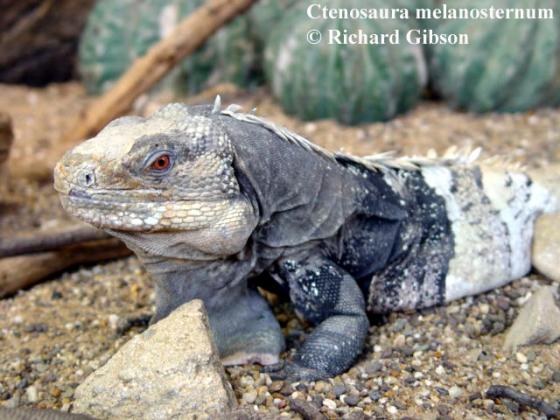


Can you confirm these amateur observations of Ctenosaura melanosterna?
Ctenosaura melanosterna
Find more photos by Google images search: 
| Higher Taxa | Iguanidae, Iguania, Sauria, Squamata (lizards) |
| Subspecies | |
| Common Names | E: Black-chested Spiny-tailed Iguana |
| Synonym | Ctenosaura melanosterna BUCKLEY & AXTELL 1997 Enyaliosaurus palearis — ECHTERNACHT 1968:151 (part) Enyaliosaurus palearis — PETERS & DONOSO-BARROS, 1970:116 (part) Enyaliosaurus palearis — MEYER & WILSON 1973:24-5 (part) Enyaliosaurus palearis — WILSON & HAHN, 1973:115 (part) Enyaliosaurus palearis — IVERSON 1980 (part) Enyaliosaurus palearis — GICCA 1983: 329.1 (part) Enyaliosaurus palearis — WILSON 1983: 125 (part) Ctenosaura palearis — ETHERIDGE 1982: 19 (part) Ctenosaura palearis — VILLA et al., 1988: 45 (part) Ctenosaura palearis — BUCKLEY & AXTELL 1990: 491.1-3 (part) Ctenosaura melanosterna — KÖHLER 2000: 75 Ctenosaura (Loganiosaura) melanosterna — KÖHLER et al. 2000 Ctenosaura melanosterna — KÖHLER 2008: 140 Ctenosaura melanosterna — MCCRANIE 2018 |
| Distribution | Honduras (Aguan Valley and the Cayos Cochinos/Hog Islands) Type locality: 2 km S Coyoles Central, Yoro, Honduras. |
| Reproduction | oviparous |
| Types | Holotype: KU 101441, subadult male collected by A. C. Echternacht. |
| Diagnosis | Diagnosis: Ctenosaura melanosterna can be distinguished from all but two other Clenosaura species by the presence of large, conspicuously flattened middorsal spines and a dewlap, characters it shares with C. palearis and C. bakeri. Ctenosaura melanosterna and C. palearis can be distinguished from C. bakeri by the presence of a large, pendulous dewlap that extends 0.5-3 cm below the basihyal. The dewlap is present in individuals of all sizes and is more conspicuous in adult males than females. The dewlap of C. bakeri extends no more than 0.5 cm below the basihyal in all individuals of both sexes. The tail of C. melanosterna and C. palearis has the intercalary rows of 12 or more caudal segments reduced to a single row dorsally, whereas C. bakeri has no more than eight (Buckley and Axtell, 1990). Additional characters distinguishing C. melanosterna from C. bakeri are in Table 1. Clenosaura melanosterna differs from G. palearis in having the following characteristics: (1) a conspicuously melanistic anterior trunk and forelegs in adults of both sexes (Fig. 2), C. palearis exhibits a brown to grey trunk and forelegs; (2) the lateral series of enlarged, spinous, caudal whorls (and intercalaries) similar in size to their dorsal counterparts, G. palearis has the lateral whorl spines on the proximal half of the tail enlarged, with a concomitant reduction in intercalaries, giving that half of the tail a laterally expanded appearance similar to that seen in G. quinquecarinata; (3) the posterior venter cream to white, C. palearis exhibits continuations of the dark dorsal crossbands onto the posterior venter; (4) proximal subcaudal banding pale or ab sent, banding remains in adult C. palearis. In addition, sexual dimorphism occurs in smaller individuals of C. palearis, indicating that it matures more rapidly or has a smaller adult size than C. melanosterna. Finally, C. melanosterna differs from C. palearis in modal number, range, and mean for 14 of 19 characters in Table 1. (Buckley & Axtell 1997) Unfortunately we had to temporarily remove additional information as this was scraped by multiple AI companies who sell that data. However, these details, e.g. detailed descriptions (about between half a page and a page) are available for collaborators and contributors. Please contact us if you need any of this material. |
| Comment | Synonymy: mostly after Buckley & Axtell 1997. Similar species: Its closest phylogenetic affinities are with C. palearis from the Motagua Valley in Guatemala with which it has previously been considered conspecific. |
| Etymology | The specific name melanosterna is derived from the Greek melanos (black) and sternon (chest), and refers ‘‘to the black chest and forelegs possessed by members of this species’’ (Buckley and Axtell, 1997: 139). Those black areas seem to occur only, or are at least stronger, in adult males. |
| References |
|
| External links |