
Lachesis melanocephala SOLÓRZANO & CERDAS, 1986


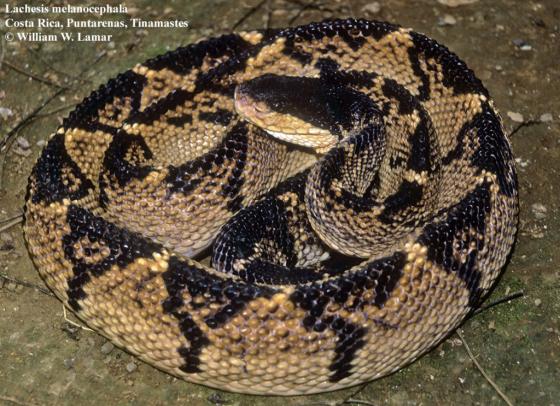
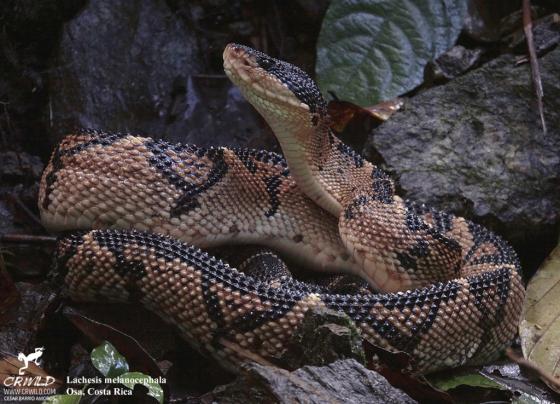
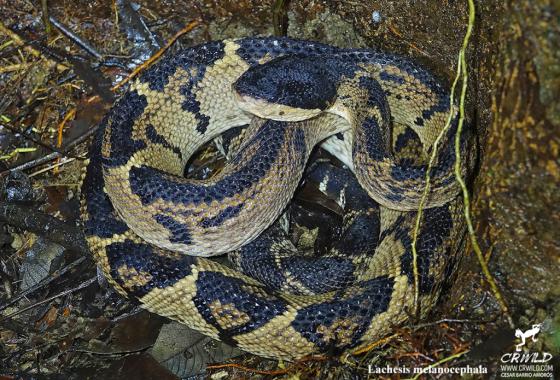
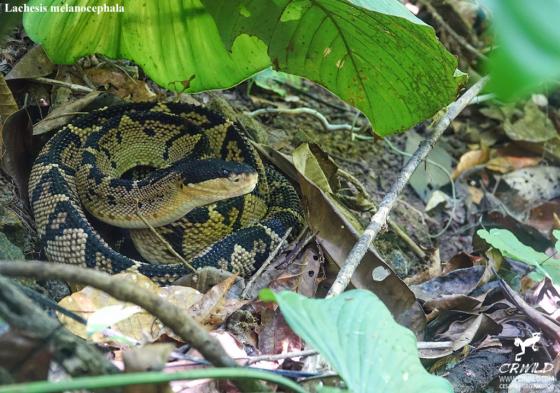
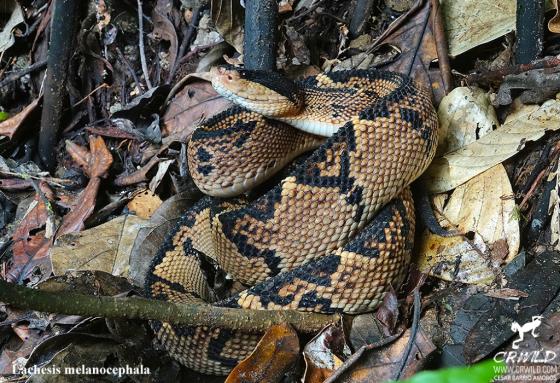

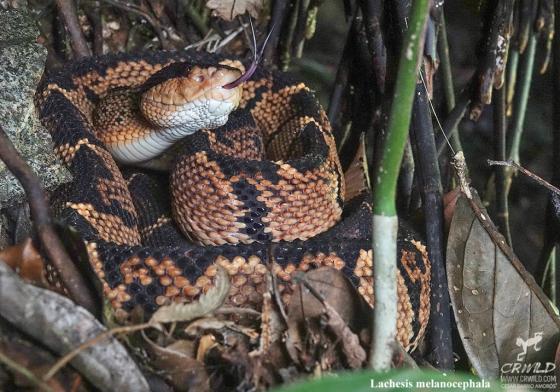
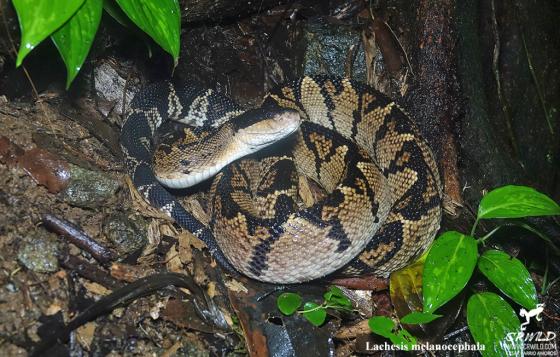


Can you confirm these amateur observations of Lachesis melanocephala?
Lachesis melanocephala
Find more photos by Google images search: 
| Higher Taxa | Viperidae, Crotalinae, Colubroidea, Caenophidia, Alethinophidia, Serpentes, Squamata (snakes) |
| Subspecies | |
| Common Names | E: Black-headed bushmaster G: Schwarzkopf-Buschmeister |
| Synonym | Lachesis muta melanocephala SOLÓRZANO & CERDAS 1986 Crotalus mutus LINNAEUS 1766 (part.) Lachesis mutus — DAUDIN 1803 (part.) Lachesis muta melanocephala — WELCH 1994: 69 Lachesis melanocephala — ZAMUDIO & GREENE 1997 Lachesis melanocephala — MCDIARMID, CAMPBELL & TOURÉ 1999: 312 Lachesis melanocephala — SAVAGE 2002 Lachesis melanocephala — WALLACH et al. 2014: 355 |
| Distribution | SW Costa Rica (Pacific coast, especially Osa peninsula), NW Panama Type locality: "tropical rainforest 9 km northern [sic] of Ciudad Neily in southeastern Provincia de Puntarenas, Costa Rica." |
| Reproduction | oviparous |
| Types | Neotype: UCR (given as MZUCR) 23185, adult male, designated by Solórzano & Sasa 2020. Holotype: ICP (also as MICP, Universidad de Costa Rica) 301, apparently now lost; paratypes: MICP 302–307. Entiauspe-Neto 2021 stated that the neotype designation by Solórzano & Sasa (2020) is invalid as it did not clarify the taxonomic status or the type locality (Article 75.3.1). |
| Diagnosis | Diagnosis: A very large, relatively slender pitviper, distinctive in having a rather broad and blunt head that is uniform black above and the tail tip covered by small scales above and below and terminating in a long, pointed spine. The dorsal color pattern is characteristic in having large dark (but often light-centered) diamonds along the midline with the lateral tips pointed ventrally and usually continuing downward as dark lines and the anterior lateral blotches forming vertical bars. (Savage 2002: 730) Additional details (2404 characters) are available for collaborators and contributors. Please contact us for details. |
| Comment | Venomous! Distribution: see maps in González-Maya et al. 2014, Solórzano & Sasa 2020, and Barrio-Amorós et al. 2020 (Fig. 28). |
| Etymology | The specific name melanocephala is derived from the Greek melanos (= black) and kephalos (= head), an allusion to the solid black top of the head in this species. |
| References |
|
| External links |