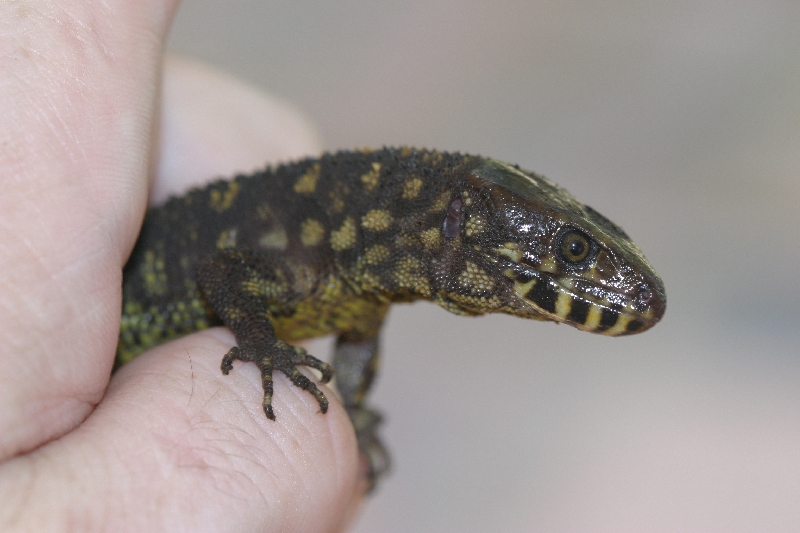
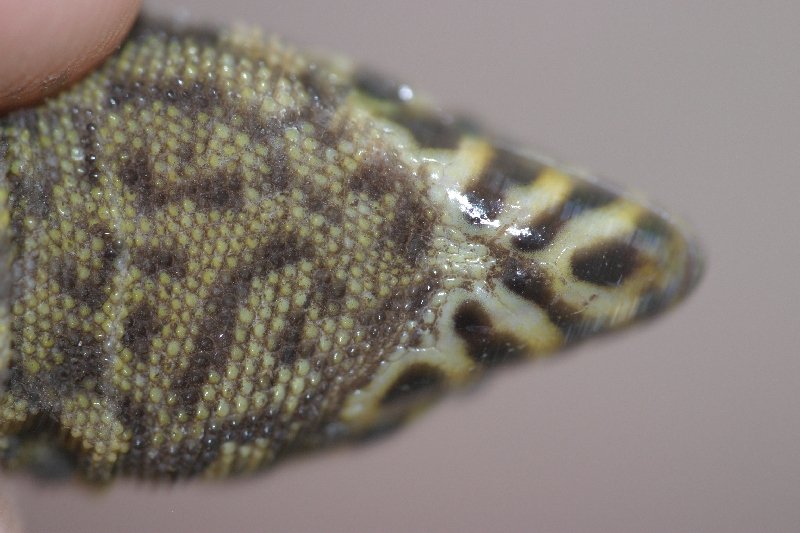
| Diagnosis | DIAGNOSIS (DIAGNOSTIC CHARACTERS). The species differs from all other Lepidophyma except L. smithii, L. flavimaculatum, L. lipetzi, L. micropholis, L. occulor, and L. sylvaticum in having 193 or more dorsals; from L. micropholis in having 229 or fewer dorsals; from L. dontomasi, L. radula, L. tarascae, L. lineri, and L. occulor in having 27 or more femoral pores; from L. lipetzi in having 33 or fewer femoral pores; from L. smithii, L. tarascae, L. lineri, and L. occulor in having 28 or more lateral tubercle rows; from L. sylvaticum in having a lower second postorbital supralabial (RSLH 0.71 or less); and from L. flavimaculatum in having a boldly reticulated color pattern on the gular surface (from BEZY & CAMARILLO 2002). |
| References |
- Arias, Erick; Federico Bolaños 2014. A checklist of the amphibians and reptiles of San Isidro de Dota, Reserva Forestal Los Santos, Costa Rica. Check List 10 (4): 870-877 - get paper here
- Baum, T. J., Barrio-Amorós, C. L., & Kaiser, H. 2024. A reptile dysfunction: tail bifurcation in the Costa Rican Tropical Night Lizard, Lepidophyma reticulatum Taylor, 1955, a first for the family Xantusiidae. Herpetology Notes 17: 815-816
- Bezy, R L 2019. Night Lizards. Field Memoirs and a Summary of the Xantusiidae. ECO Herpetological Publishing and Distribution, Rodeo, New Mexico, ii + 220 pp. [review in HR 51 (3): 636] - get paper here
- Bezy, R. 2024. Photos of Type Specimens of Lepidophyma (Reptilia: Squamata: Xantusiidae) ResearchGate - get paper here
- Bezy, R.L. 1989. Morphological differentiation in unisexual and bisexual xantusiid lizards of the genus Lepidophyma in Central America. Herpetological Monographs 3: 61-80 - get paper here
- Bezy,R.L. & Camarillo, J.L. 2002. SYSTEMATICS OF XANTUSIID LIZARDS OF THE GENUS LEPIDOPHYMA. Contributions in Science (493): 1–41 - get paper here
- Köhler, G. 2000. Reptilien und Amphibien Mittelamerikas, Bd 1: Krokodile, Schildkröten, Echsen. Herpeton Verlag, Offenbach, 158 pp.
- Lotzkat, Sebastian 2014. Diversity, taxonomy, and biogeography of the reptiles inhabiting the highlands of the Cordillera Central (Serranía de Talamanca and Serranía de Tabasará) in western Panama. PhD thesis, Goethe-Universität Frankfurt am Main, 930 pp. - get paper here
- Peters, James A. & Donoso-Barros, Roberto 1970. Catalogue of the Neotropical Squamata: Part II. Lizards and Amphisbaenians. Bull. US Natl. Mus. 297: 293 pp. - get paper here
- Salazar-Saavedra, Milton 2025. Listado de los Anfibios y Reptiles de Nicaragua con la<br />inclusión de 24 nuevos registros para el país. Revista Nicaragü ense de Biodiversidad. (114): 144 pp. - get paper here
- Santos-Barrera, Georgina; Jesus Pacheco, Fernando Mendoza-Quijano, Federico Bolaños,<br />Gerardo Cháves , Gretchen C. Daily, Paul R. Ehrlich & Gerardo Ceballos 2008. Diversity, natural history and conservation of amphibians and reptiles from the San Vito Region, southwestern Costa Rica. Rev. Biol. Trop. 56 (2): 755-778 - get paper here
- Sasa, M., Arias, E., & Chaves, G. 2025. Annotated list of amphibians and reptiles of Costa Rica: The role of the Museum of Zoology in cataloging the country’s herpetological diversity. Revista de Biología Tropical, 73(S2): e64536-e64536 - get paper here
- Savage, J.M. 2002. The Amphibians and Reptiles of Costa Rica: A Herpetofauna Between Two Continents, Between Two Seas. University of Chicago Press, 934 pp. [review in Copeia 2003 (1): 205]
- Taylor, E. H. 1956. A review of the lizards of Costa Rica. Univ. Kansas Sci. Bull. 38 (part 1): 3-322 - get paper here
- Taylor,E.H. 1955. Additions to the known herpetological fauna of Costa Rica with comments on other species. No. II. Univ. Kansas Sci. Bull. 37: 499-575. - get paper here
|