
Micrurus ornatissimus (JAN, 1858)





Can you confirm these amateur observations of Micrurus ornatissimus?
Micrurus ornatissimus
Find more photos by Google images search: 
| Higher Taxa | Elapidae, Elapoidea, Caenophidia, Alethinophidia, Serpentes, Squamata (snakes) |
| Subspecies | |
| Common Names | E: Ornate Coralsnake E: Piedmont coral snake, Steindachner's Coral Snake E: Santiago Piedmont coral snake [steindachneri] E: Pastaza Piedmont coral snake [orcesi] [steindachneri] E: Peru(vian) Coral Snake [peruvianus] E: Mountain coral snake, Peters' Coral Snake G: Peters' Korallenotter [petersi] Portuguese: Cobra-Coral, Coral-Verdadeira [tikuna] |
| Synonym | Elaps ornatissimus JAN 1858: 521 Elaps buckleyi BOULENGER 1896: 416 Elaps buckleyi — IHERING 1911: 371 Micrurus ornatissimus — SCHMIDT 1936: 191 Micrurus langsdorffi — PETERS & OREJAS-MIRANDA 1970: 211 Micrurus langsdorffi ornatissimus — PEREZ-SANTOS & MORENO 1988: 388 Micrurus langsdorffi ornatissimus — WELCH 1994: 85 Micrurus ornatissimus — LEHR 2002: 205 Micrurus ornatissimus — CARVALHO 2002 Micrurus cf. ornatissimus — BERNARDE et al. 2012 Micrurus ornatissimus — WALLACH et al. 2014: 451 Elaps Steindachneri WERNER 1901: 599 Elaps fassli WERNER 1927: 249 Micrurus steindachneri — ROZE 1967 Micrurus steindachneri — WELCH 1994: 89 Micrurus steindachneri steindachneri — FEITOSA et al. 2014 Micrurus steindachneri — WALLACH et al. 2014: 454 Micrurus steindachneri orcesi ROZE 1967 Micrurus steindachneri orcesi — KLUGE 1984 Micrurus steindachneri orcesi — FEITOSA et al. 2014 Micrurus peruvianus SCHMIDT 1936 Micrurus peruvianus — WELCH 1994: 87 Micrurus peruvianus — WALLACH et al. 2014: 452 Micrurus steindachneri petersi ROZE 1967: 45 Micrurus petersi — ROZE 1983 Micrurus petersi — WELCH 1994: 87 Micrurus petersi — WALLACH et al. 2014: 452 Micrurus tikuna FEITOSA, DA SILVA Jr, PIRES, ZAHER & COSTA-PRUDENTE 2015 Micrurus ornatissimus — SILVA-HAAD 1994: 82. Micrurus ornatissimus — CAMPBELL & LAMAR 2004: Plate 159 Micrurus tikuna — NOGUEIRA et al. 2019 |
| Distribution | Amazonian slopes of the Andes in E Ecuador, Colombia, N Peru, Brazil (Amazonas) Type locality: in error (see comment) Restricted to Amazon Basin fide K.P. Schmidt (1936b: 191), Río Putumayo, Colombia fide K.P. Schmidt (1955a: 345) and Ecuador or Peru fide Cunha & Nascimento (1982c: 8). steindachneri (invalid): E Ecuador, Peru orcesi (invalid): Ecuador (Pastaza); Type locality: Ecuador, Baños, Meta Trail, 1200 m elevation. peruvianus (invalid): Peru (Cajamarca, Amazonas), Ecuador; Type locality: Perico, Department of Cajamarca, Peru. petersi (invalid): E Ecuador; Type locality: 1 mile south of Plan de Milagro on the trail to Pan de Azücar, Morona-Santiago Province, Ecuador, 5,600 ft elevation. tikuna (invalid): Brazil (Amazonas), Colombia (Amazonas), Peru ?; Type locality: INCRA neighborhood, municipality of Tabatinga (04°14’36’’S, 69°54’15’’W; elevation ca. 80 m above sea level), state of Amazonas, Brazil |
| Reproduction | oviparous |
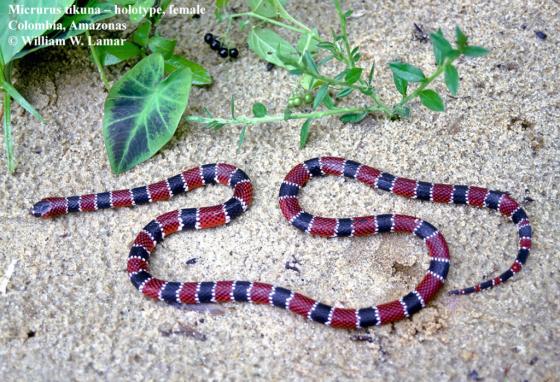
| Types | Holotype: MSNM = MilM = Milan Museum Holotype: NMW 15750, an 800 mm male (R. Haensch). Holotype: UMMZ 88922 [orcesi] [steindachneri] Holotype: MCZ 17385, a male [peruvianus] Holotype: USNM 158295, a female [petersi] Holotype: MPEG 18199, Adult female (formerly Hospital Regional de Leticia-HRL 10101), collected by Juan Silva Haad, on 1991 (Figs. 1–2). Paratype. Adult male, ICN-MHN = ICN 10853, collected by Maria Cristina Ardila, (field number MC 8531), on November 23 1996 at Km 9.5 from Leticia-Tarapacá road, Quebrada La Arenosa (02°57’58’’S, 69°48’58’’ W, ca. 110 m asl), municipality of Leticia, department of Amazonas, Colombia. [tikuna] |
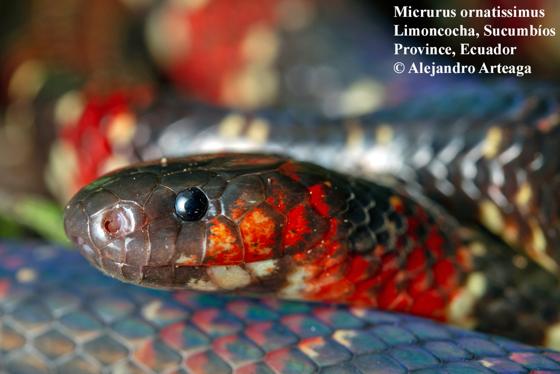
| Diagnosis | Diagnosis: A coral snake with a light spot on each supraocular shield in most specimens, black rings not in triads, the black rings edged with very narrow yellow rings that are reduced to yellow spots on half scales, so that the yellow rings are discontinuous. The red rings are subject to darkening with black pigment and the black rings to fading, producing an almost uniform coloration from which the yellow half-scales stand out as strikingly distinct spots; the venter fades to complete loss of the dark rings [from SCHMIDT 1955]. Unfortunately we had to temporarily remove additional information as this was scraped by multiple AI companies who sell that data. However, these details, e.g. detailed descriptions (about about 2.47 pages) are available for collaborators and contributors. Please contact us if you need any of this material. |
| Comment | Venomous! Synonymy partly after PETERS & OREJAS-MIRANDA 1970 and Valencia et al. 2026 (who synonymized steindachneri, peruvianus, petersi, and tikuna with ornatissimus). Distribution: Some populations of ornatissimus from Western Amazonia have been split off as Micrurus tikuna. Not in Brazil fide Nogueira et al 2019 (Atlas). Distribution: M. tikuna was not recorded from Peru but the type locality is very close to the Peruvian border, hence the species is likely present there as well. See map in Nogueira et al. 2019. The type locality of ornatissimus was erroneously given as “Mexico” (fide SCHMIDT 1936). RDB speciesID: 16446 [steindachneri] RDB speciesID: 16430 [peruvianus] RDB speciesID: 16431 [petersi] RDB speciesID: 20210 [tikuna] Etymology (steindachneri): Named after Franz Steindachner (1834-1919), Austrian zoologist. Obituary in Pietschmann (1919). Etymology (orcesi): M. s. orcesi was named after Prof. G. Orcés-V., an Ecuadorian zoologist who provided his large cora snake collection to Janis Roze. Etymology (peruvianus): Named after its distribution in Peru. Etymology (petersi): Named after James A. Peters (1922-1972), American herpetologist, specializing on South American reptiles. Etymology (tikuna): The specific epithet “tikuna” is a name in apposition derived from Tupi indigenous word “tacouma,” meaning a man with their face or nose painted with black (Gregório 1980). Tikuna also refers to the native Indian nation that originally occupied the western Amazon region along the upper Solimões River near the boundaries between Brazil, Colombia and Peru. Similar to the Tikuna Indians, the new species of Micrurus has a predominantly black head. |
| Etymology | The name ornatissimus is Latin for very ornate or decorated, probably alluding to the light head spots and the pearly white crossbands that, in combination with the brilliant red bands, make it look quite "ornamentissimus" in life. |
| References |
|
| External links |
|